
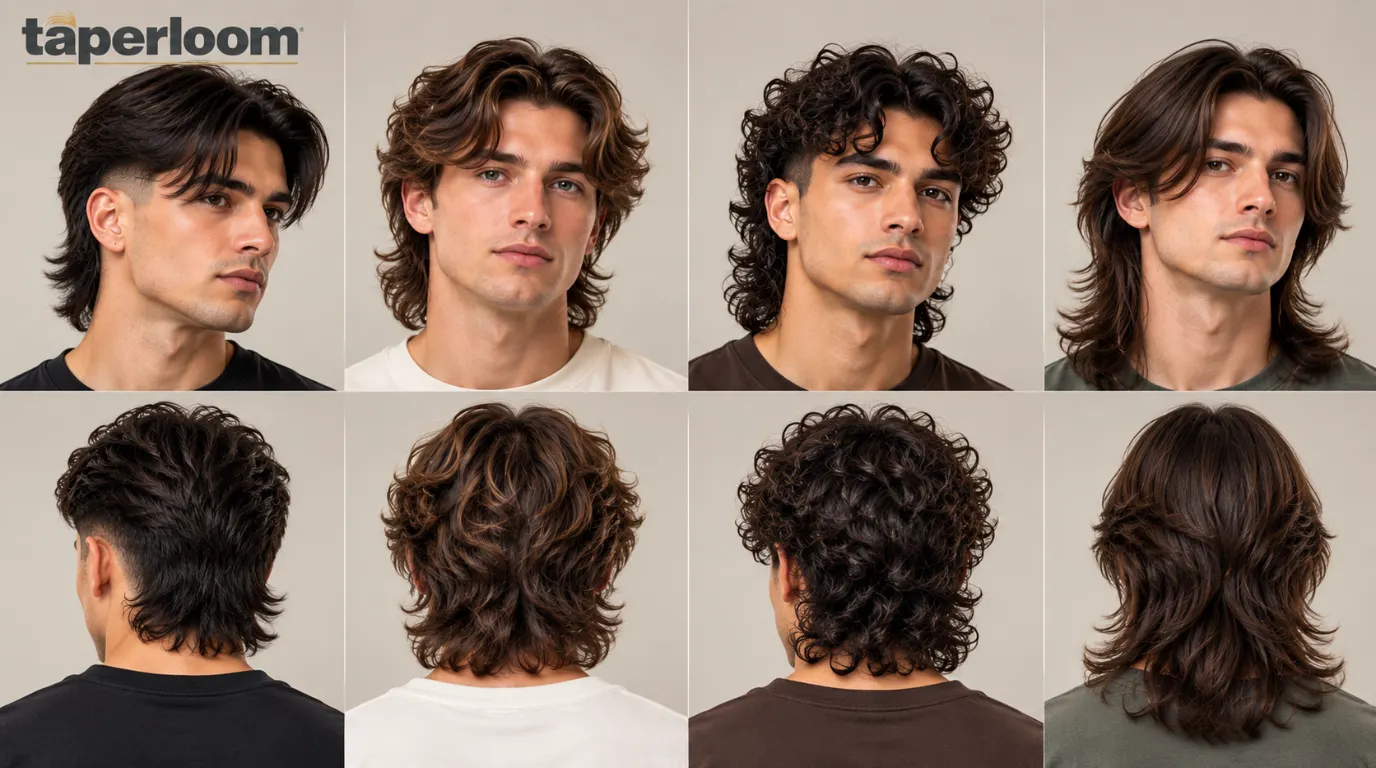
Quick answer: A middle part modern mullet has shorter sides, a longer back and a center part that splits the top into soft curtains. Choose a baby or short version for work, a taper or fade for a sharper finish, and layers or waves for a relaxed look. Plan a trim every 3 to 6 weeks.
The middle part modern mullet takes the old short-front, long-back idea and softens it. The layers blend, the part frames the face and the whole shape looks deliberate rather than costume-like.
It works on straight, wavy and curly hair, and it can be made neat enough for an office or loud enough for a photo shoot.
This guide covers 30+ styles grouped by length, fade, texture and finish, plus face shape and hair type matching, a barber script, step-by-step styling, growing-out timelines and the mistakes that ruin the cut.
Key takeaways
- Not sure? Start with a short or baby version and ask the barber to leave extra length.
- Tapers are subtle and low-maintenance; skin fades look sharper but need trims every 2 to 3 weeks.
- Hair type decides the cut: straight hair needs precision, wavy hair needs light layers, curly hair needs room in the back.
- A center part works best when it follows how your hair naturally grows, so check your cowlicks first.
What Is a Middle Part Modern Mullet?
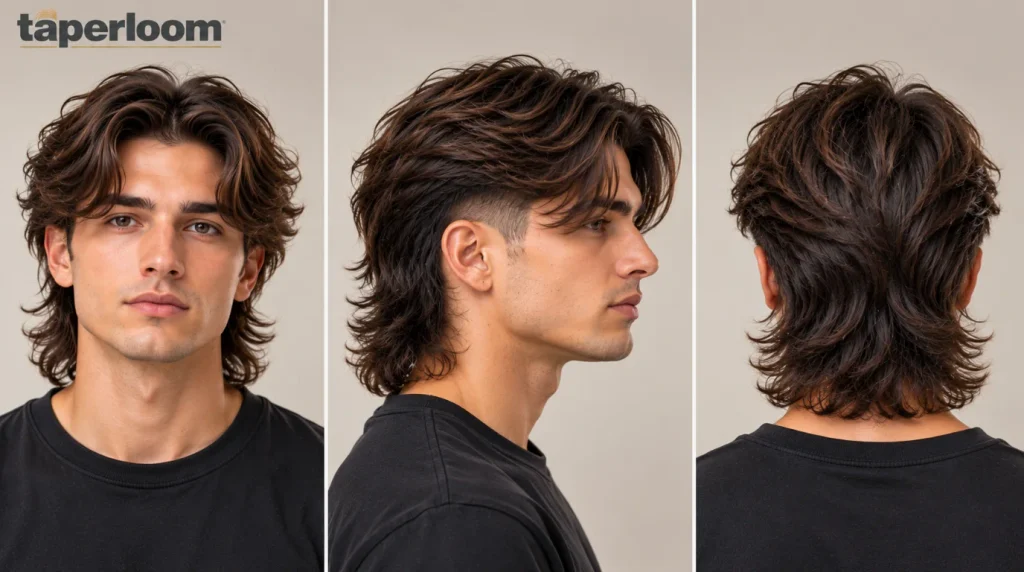
A middle part modern mullet is a haircut with shorter sides and top, a longer back and a center part that divides the front into curtain-like sections.
The back can sit just above the collar or fall past the shoulders.
How It Differs From a Classic Mullet
The classic mullet has a sharp jump between short front and long back, usually with the front swept back.
The modern version blends the lengths with layers, tapers or fades and replaces the swept-back front with a center part. The result looks softer and more current.
Barber Terms Worth Knowing
- Taper: sides gradually shorten toward the ears and neckline.
- Fade: the sides shorten faster, sometimes to bare skin.
- Point cutting / razor cutting: techniques that break up the ends for movement.
- Nape: the back of the neck, where the tail begins.
- Crown: the top-back swirl where hair often grows in a spiral.
- Cowlick: a section that grows against the direction you want.
Middle Part Mullet vs Wolf Cut, Shag, Curtains and Other Cuts
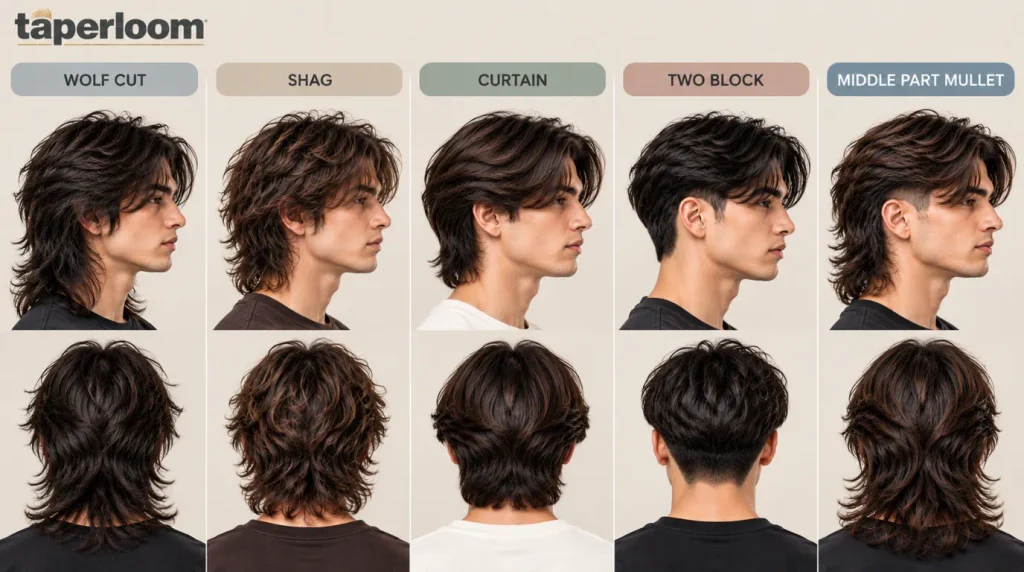
| Haircut | Key difference | Back length |
| Middle part modern mullet | Clear short-sides, long-back shape with a center part | Collar to past shoulders |
| Wolf cut | Heavy layers all over, rounder and fuller | Medium |
| Shag | Choppy layers throughout, little contrast | Medium |
| Curtain haircut | Center part, even length, no elongated back | Short to medium |
| Two block | Very short sides, longer top | Short |
| Burst fade mullet | Rounded fade around the ear; may not use a center part | Medium to long |
| Quiff / pompadour mullet | Lifted, swept-up front rather than a center part | Medium to long |
| Side part mullet | Part on one side; cleaner, more classic | Medium |
Barbers often blend these, so bring photos instead of relying on names.
Why the Middle Part Modern Mullet Is Popular in 2026
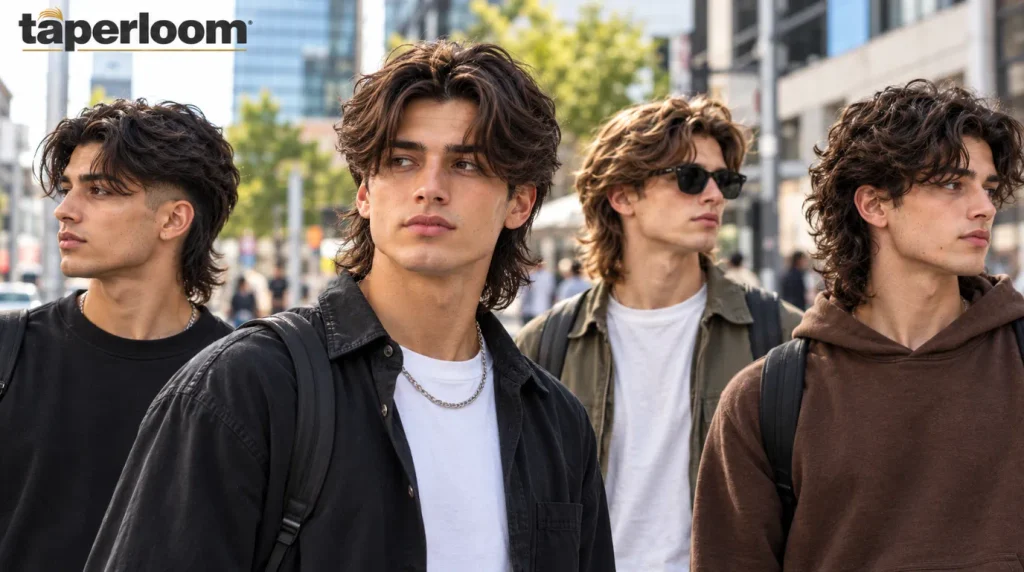
Three things drive it: nostalgia for 90s hair, social media sharing of before-and-after transformations, and a wider acceptance of longer hair, soft parts and visible texture on men. Its flexibility helps too.
It can look neat or messy and subtle or bold depending on how it is cut and styled.
Middle Part Modern Mullet Styles by Length
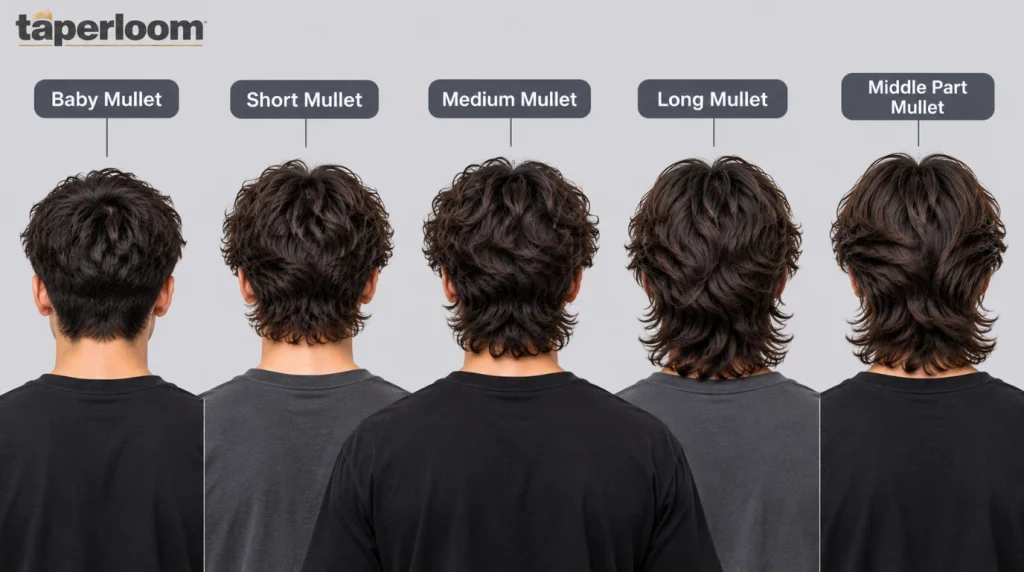
1. Baby Middle Part Mullet
The back is only slightly longer than the sides, so the cut reads as a hint rather than a statement. It suits first-timers and strict dress codes.
2. Short Middle Part Mullet
The back reaches the nape or just over the collar. You keep the mullet shape without a long tail, and it is easy to manage for school or the office.
3. Medium Soft Drop Mullet
The length drops gradually toward the back, creating a smooth transition with no harsh edges. This is the most balanced all-round length for casual and semi-formal settings.
4. Long Middle Part Mullet
The back grows past the shoulders while the part frames the front. It looks dramatic and needs patience, regular conditioning and trims to keep the ends from fraying.
5. Long Tail Middle Part Mullet
A thin strip of extra length sits at the very back, a nod to the retro and country-style mullet with a cleaner finish. Keep the rest of the cut tidy so the tail looks intentional.
Middle Part Modern Mullet Styles by Fade and Taper
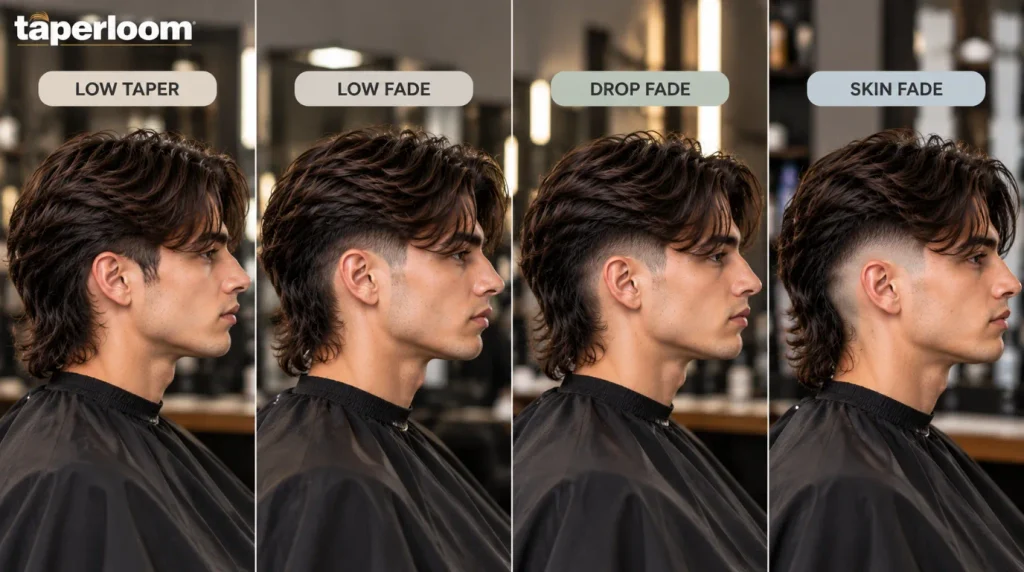
6. Low Taper Mullet
The sides taper just above the ear and follow the hairline. It is subtle, grows out gracefully and keeps contrast gentle.
7. Taper Fade Mullet
This combines neat edges with a gradual blend. It sits between soft and sharp and suits almost any hair type, and most barbers know how to cut it.
8. Low Fade Mullet
The sides shorten quickly near the ears and neckline, often to the skin. It is sharper than a taper and gives a crisp outline against the longer top.
9. Drop Fade Mullet
The fade curves down behind the ear, following the shape of the head. It leads the eye toward the back and flatters a pronounced tail.
10. Skin Fade Mullet
Sides go to bare skin before blending upward, creating strong contrast. Expect barber visits every 2 to 3 weeks, because skin fades lose sharpness quickly.
11. Burst Fade Mullet
The fade curves in a half-circle around the ear and leaves the nape fuller. It works especially well with curls and a center part.
12. Undercut or Two Block Mullet
Hair underneath is removed so the longer top falls over it. It removes bulk, which helps thick hair, and the top can be worn down or tied back.
Middle Part Modern Mullet Styles by Hair Type and Texture
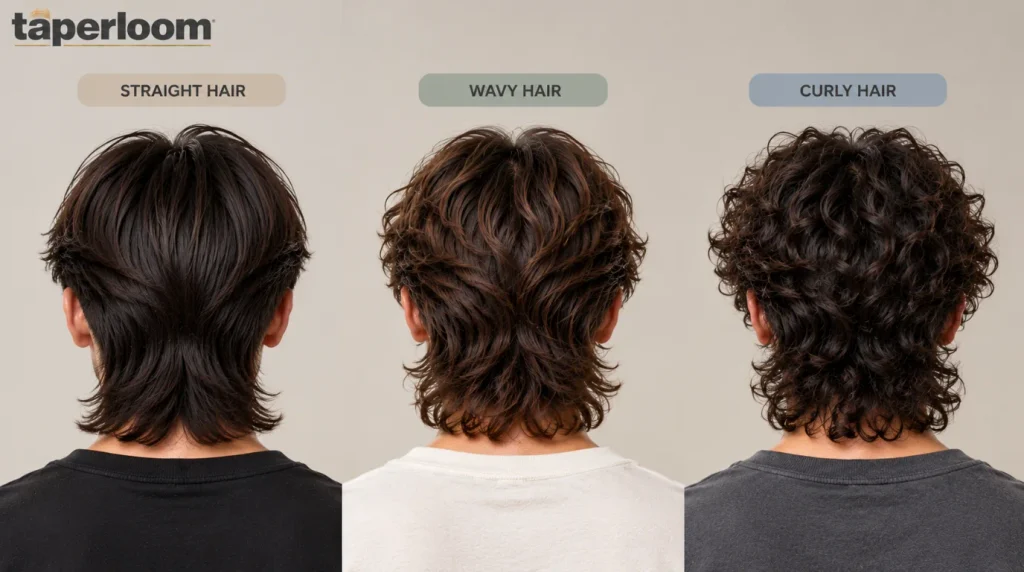
13. Straight, Sleek Middle Part Mullet
Straight hair gives a polished look with a crisp part and a smooth back line. With no natural wave to hide mistakes, the cut must be precise, so choose an experienced barber.
14. Wavy and Loose Wave Mullet
Waves bend around the part and give the back a lived-in shape. A light sea salt spray or cream is usually enough, and the style needs little daily effort.
15. Curly Middle Part Mullet
Curls add volume to the back while the part keeps the front from getting bulky. Use curl cream, avoid dry brushing and diffuse on low heat. A permed version creates the same effect with tighter, defined curls.
16. Thick, Straight Hair Mullet
Thick straight hair can flare out if left uncut. Thinning and layering help it lie flat, and a soft taper on the sides keeps the outline clean.
17. Textured Middle Part Mullet
Cutting at different lengths with a razor or thinning shears gives a relaxed, slightly messy finish. Use matte paste, because shiny products flatten the texture.
18. Heavy Texture Mullet
Choppy sections and visible separation make a louder, grittier shape. It works best on medium to thick hair; very fine hair can look sparse with aggressive cutting.
19. Soft Layered and Curved Flow Mullet
Feathered or curved layers follow the shape of the head so the hair wraps around the face and falls gently at the back. It looks balanced from every angle and grows out without an awkward stage.
20. Shaggy Middle Part Mullet
Uneven ends and visible layers give a carefree look that needs little more than air drying and some paste.
21. Wolf Cut Middle Part Mullet
Heavy layers around the crown meet a tapered, wispy back. It is bold and suits thick hair that can carry the weight.
Middle Part Modern Mullet Styles by Front and Finish
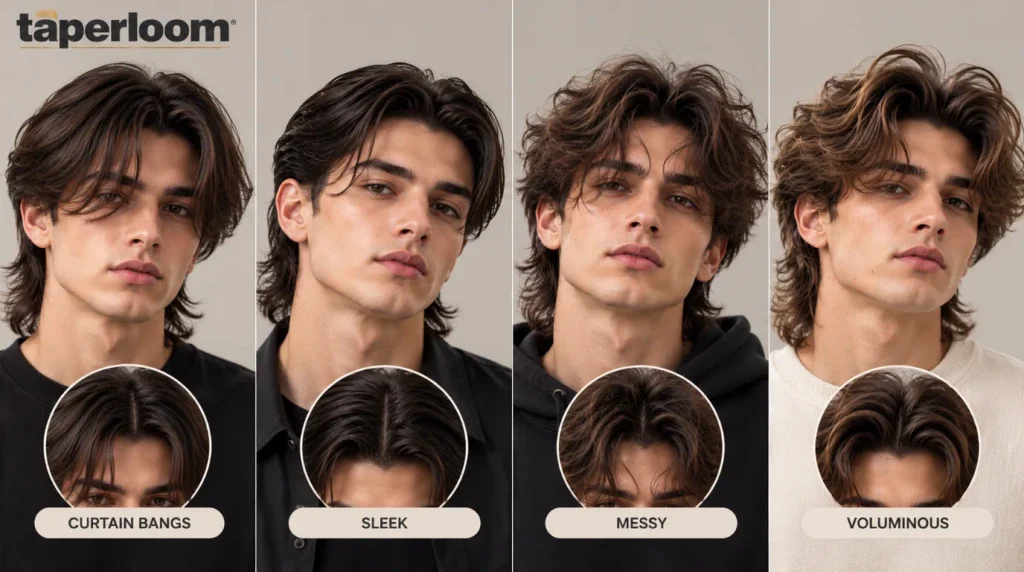
22. Curtain Bangs Mullet
Bangs sweep away from the center and brush past the cheekbones, adding a soft 90s feel. A small curved “comma” fringe works the same way. It flatters most face shapes and softens a strong forehead or jawline.
23. Soft Divider and Minimal Precision Mullet
A neat, perfectly aligned part, light layering and no excess volume. This is the most professional version.
24. Editorial Volume Mullet
Roots are lifted for a fuller, fashion-led shape. The center part emphasizes symmetry, and the back flows in a controlled way.
25. Korean Middle Part Mullet
Lighter and thinned out, with a gentle part and a short-to-medium back. It pairs well with a clean, polished wardrobe.
26. Messy Middle Part Mullet
Rough on purpose: loose pieces and uneven ends. Run your fingers through it, add a little clay and leave it alone. Over-styling ruins the effect.
27. Edgy High-Contrast Mullet
Heavy texture, a dramatic length difference and sometimes highlights or dye give this version attitude. Ash, deep brown and blonde tones are common choices.
28. Flipped-Ends Mullet
The ends flick outward through cutting angles and a bit of heat styling. A small round brush and a light hairspray do the job.
29. V-Shaped Back Mullet
The back tapers to a point in the center. It looks neat on straight or wavy hair but is harder to see on curls, and it needs a barber who has done it before.
30. Mullet With Sideburns or a Beard
Medium sideburns add a rock-and-roll edge, and a short, groomed beard adds structure that balances the volume. Keep the beard line sharp so the whole look does not turn heavy.
31. Balanced Edge Mullet
Crisp edges, a clean neckline and equal weight on both sides of the part give a groomed, deliberate finish. It needs regular trims to stay sharp.
How to Choose by Face Shape and Hair Type
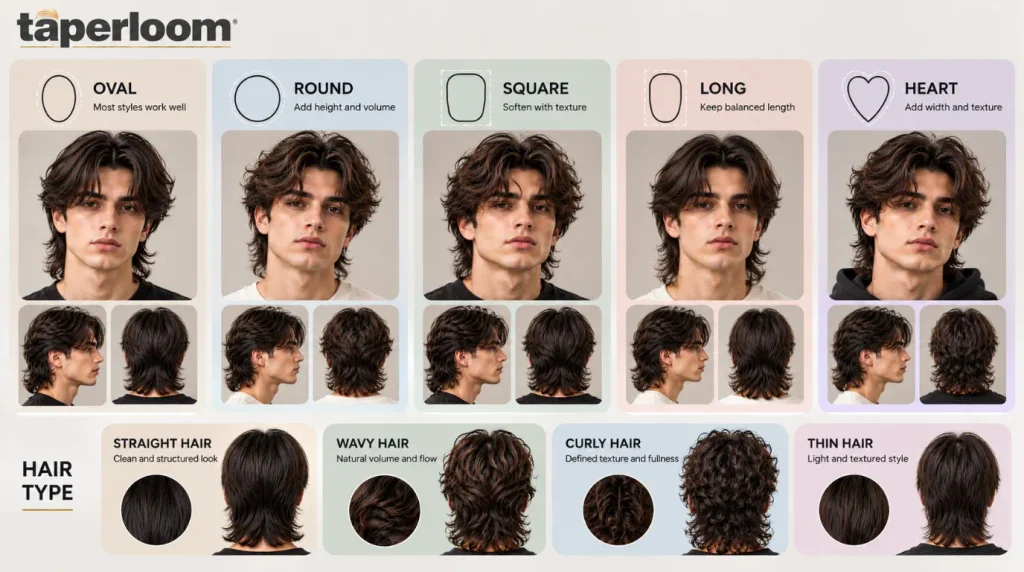
Face Shape Table
| Face shape | What works | Try |
| Oval | Almost any version | Classic, layered, modern |
| Round | Height at the crown, longer layers | Voluminous, layered, V-shaped back |
| Square | Soft, wavy texture | Wavy, curved layers, textured |
| Long / narrow | Volume at the sides, curtain bangs | Curtain bangs, shaggy |
| Heart | Fuller layers near the jaw | Soft layered, medium drop |
Hair Type Table
| Hair type | Ask for | Try |
| Straight | Precise cut, crisp part | Sleek, soft divider |
| Wavy | Light layers, minimal product | Loose wave, textured |
| Curly | Volume in the back, no dry brushing | Curly, burst fade |
| Thick / coarse | Thinning or undercut to remove bulk | Undercut, layered, wolf cut |
| Fine / thin | Light layers, shorter and tidy | Baby, short, taper |
Who May Want a Different Cut
Very fine, flat hair may look sparse with a long back, and a strong cowlick at the front hairline can fight a center part. A receding hairline can still work with a center part if you keep the top fuller and avoid very short sides. Ask your barber to check your growth pattern first.
Read Also Modern Mullet Curly Hair for Men: Styles, Cuts, Styling and Care Guide (2026)
How to Choose the Right Length
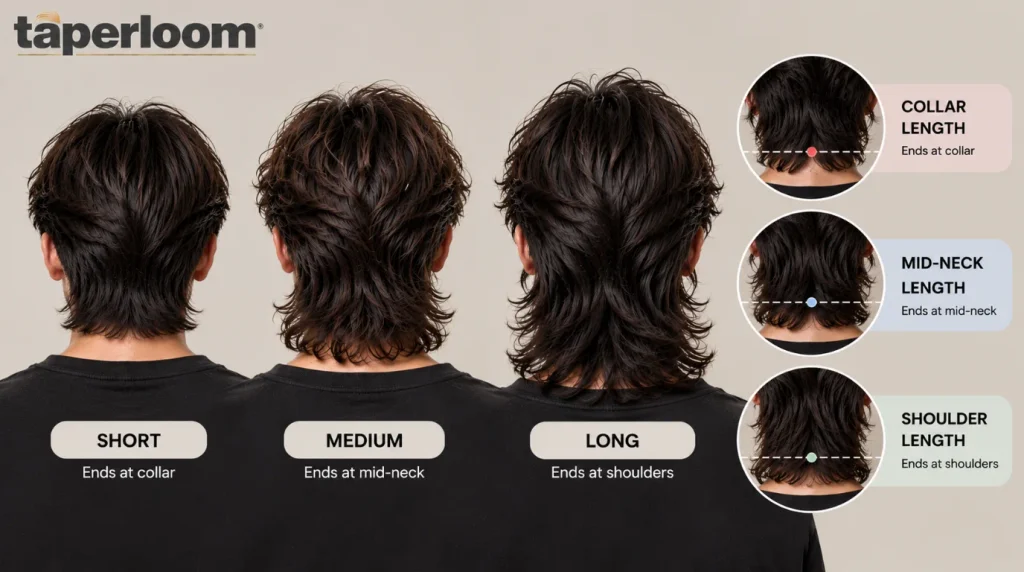
Straight hair looks longer than it is, while curly hair shrinks as it dries and often needs extra length. For formal settings keep the back near the collar; for casual or creative settings shoulder length works.
Starting medium leaves room to grow or trim later. You need about three to four inches on top to show a clear part.
Is a Middle Part Modern Mullet Work-Appropriate?

It depends on the workplace. Creative fields, tech and casual offices usually accept it. In stricter settings choose a short or baby version with a taper, or tie the back hair or tuck it behind the collar.
Clean edges and healthy ends do more for a professional look than the length itself.
How to Ask Your Barber for a Middle Part Modern Mullet
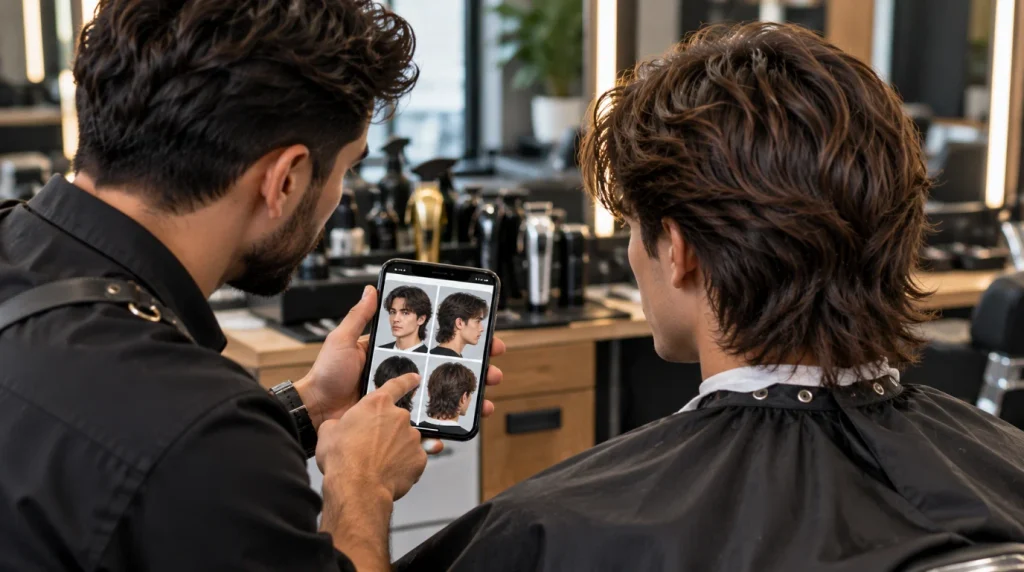
- “I want a middle part modern mullet. Here are 2 to 3 reference photos (front, side, back).”
- Sides: short taper, low fade or natural (choose one).
- Back: collar, mid-neck or shoulder length (choose one).
- Top: layered with a center part and light texture.
- “Please leave extra length for now. I’ll decide on more off at the next visit.”
- “How should I style it at home?”
Also tell the barber your daily styling time and how often you plan to come back.
How to Style a Middle Part Modern Mullet Step by Step
- Start with damp hair. Towel dry until it stops dripping.
- Prep. Use sea salt spray for texture or mousse for volume.
- Find your part. Use a comb from the center of the forehead back to the crown.
- Blow-dry. Use medium heat, directing the front away from the part and lifting the roots. A heat protectant helps.
- Shape the back. Let it fall naturally, or use a round brush for flipped ends.
- Finish. Rub a small amount of matte paste or clay between your palms and work it through.
- Set. A light hairspray locks it in without stiffness.
Curly hair skips the brush: scrunch in curl cream and air dry or diffuse. Styling takes about 5 to 10 minutes once practiced.
Best Products by Hair Type
- Straight: light texture cream or powder
- Wavy: sea salt spray and light cream
- Curly: curl cream and leave-in conditioner
- Fine: mousse and powder
- Thick: smoothing serum and a flexible clay
- Skip: heavy waxes and greasy gels, which flatten movement
Maintenance, Trims and Growing Out
Trim every 3 to 5 weeks for most versions, every 2 to 3 weeks for skin fades and up to 6 weeks for relaxed, low-taper styles.
Wash two to three times a week with a gentle shampoo and use conditioner or a leave-in on the ends.
Growing it out: hair grows roughly half an inch a month on average. From a regular haircut, expect about 4 to 6 months for a short-to-medium version and 8 to 12 months or more for shoulder length. Ask for light shaping trims to keep the sides neat while the back grows.
Common Mistakes to Avoid
- Going too short in the back, so it looks like a layered cut
- Ignoring hair type and cowlicks
- Using heavy products
- Skipping trims, which exposes split ends
- Forcing a part against your natural growth
- Copying a photo without considering your hair thickness
- Being vague with the barber about fade type and length
Outfit and Style Pairings
For a casual 90s look, pair it with oversized tees, denim jackets, flannel and sneakers. For a sharper style, try tailored blazers, crisp shirts and leather shoes. For streetwear, go with cargo pants, graphic hoodies and chunky trainers.
FAQs
What is a middle part modern mullet?
It is a haircut with a center part, shorter sides and a longer, blended back. The layers soften the contrast of the classic mullet.
What face shapes suit it?
Oval faces suit nearly every version. Round faces benefit from crown height, square faces from soft waves, long faces from curtain bangs and side volume.
Does it work with straight, wavy and curly hair?
Yes. Straight hair needs a precise cut, wavy hair needs light layers and curly hair needs room in the back.
Can I get it with thin or fine hair?
Yes, but keep layers light and go shorter, because heavy cutting can look sparse.
How long does hair need to be?
About three to four inches on top for a visible part, with the back a couple of inches longer than the sides.
Should the part be perfectly centered?
Not always. A slightly off-center part often looks more natural; aim for exact center only for a polished look.
How often should I trim it?
Every 3 to 5 weeks, or 2 to 3 weeks with a skin fade.
How do I keep it from looking flat?
Use mousse at the roots, blow-dry upward and ask for light crown layers. Avoid heavy oils on top.
Is it the same as a wolf cut?
No. A wolf cut uses heavy layers all over, while the mullet keeps a short-sides, long-back structure.
Can I get it without a fade?
Yes. Natural, layered or tapered sides all work.
Final Thoughts
The middle part modern mullet works because it is adjustable: short or long, sleek or messy, faded or natural.
Start with your hair type and how much styling time you want, bring clear photos and ask for extra length at first. Hair grows back, so it is a low-risk change.
Read Next : Hairstyles for Men: Haircut Names, Styles and How to Pick Yours

Muhammad Kaleem is a content creator who writes about hair care, hairstyles, grooming, and everyday hair trends. He enjoys turning hair-related topics into simple, practical, and easy-to-understand content that helps readers make informed choices about their hair and personal style.