
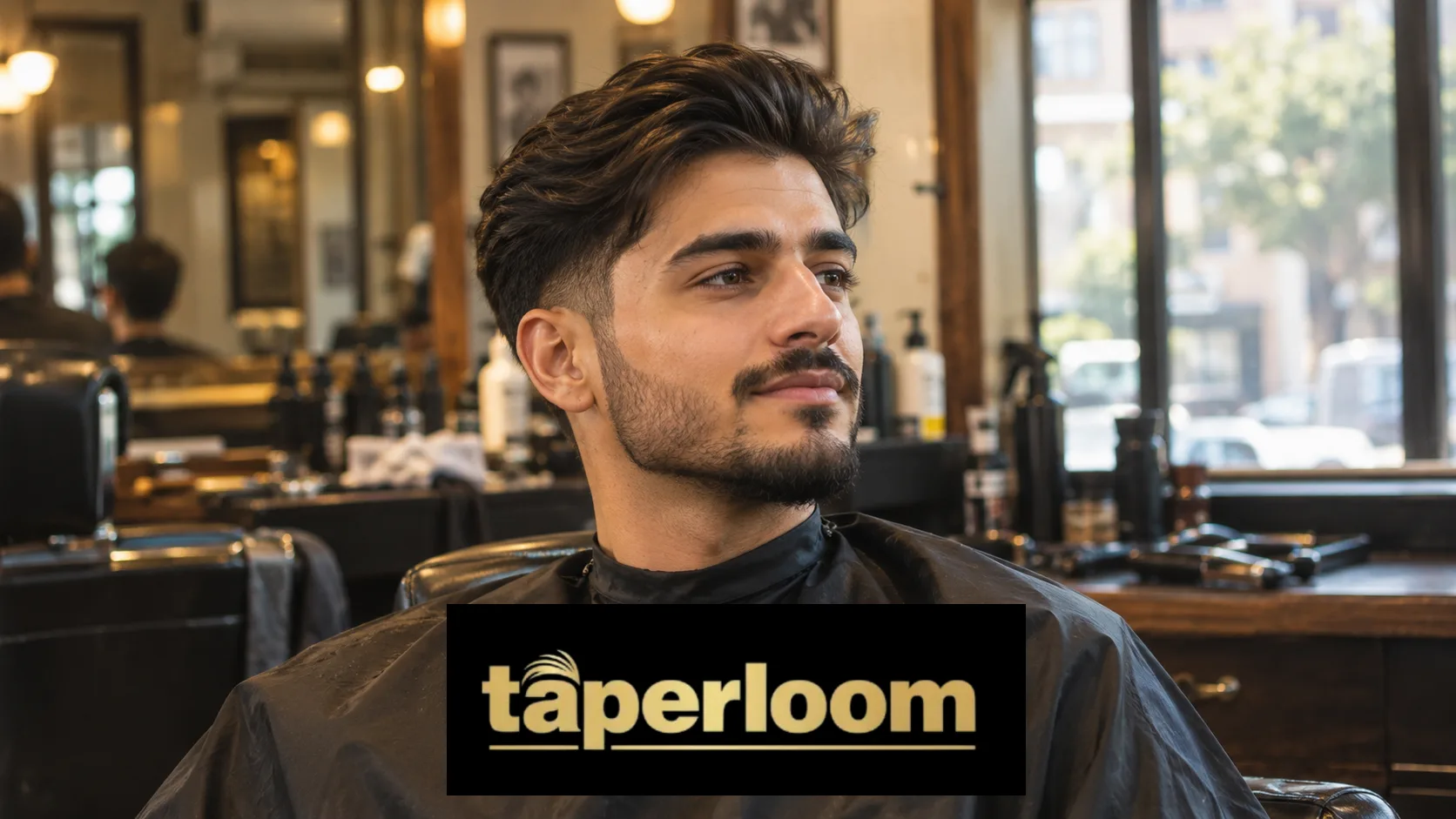
A classic taper haircut keeps your hair long enough on top to style, then shortens it gradually down the sides without ever showing skin. It’s the cut barbers reach for when a client says “just make me look put together.”
This guide gives you 65 real styles, the exact clipper numbers to ask for, and a script that works in any barbershop.
A classic taper haircut keeps 2 to 4 inches on top and gradually shortens the sides and back down to the neckline, without exposing the skin. It’s the most requested men’s cut in American barbershops because it works for every hair type, face shape, and dress code, and it holds its shape for 4 to 6 weeks between visits.
At a Glance
| Top length | 2 to 4 inches |
| Side guards | #3 upper to #1 lower |
| Maintenance | Every 4 to 6 weeks |
| Best for | All hair types, all face shapes, formal settings |
| Chair time | 20 to 30 minutes |
| Cost range | $20 to $60, varies by city |
| Skill level to ask for | Easy, any barber can do this |
Key Takeaways
A classic taper never exposes skin, that’s what separates it from a taper fade. It works on straight, wavy, curly, and coily hair without changes to the technique.
Low, mid, and high taper heights control how much contrast you get. It holds its shape 4 to 6 weeks, longer than any fade variation. One script gets you the right cut at any barbershop, anywhere.
What Is a Classic Taper Haircut?
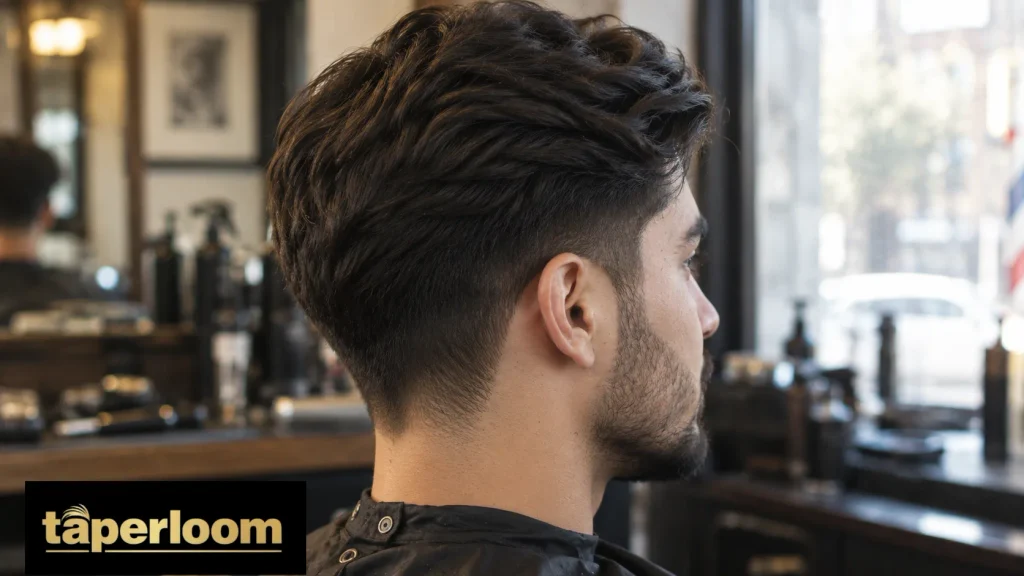
A classic taper haircut is a men’s cut where the hair stays longest on top, usually 2 to 4 inches, and gradually shortens as it moves down the sides and back toward the neckline and ears. The barber blends it with clippers and scissors so there’s no visible line, and the skin never shows through.
Three things make the structure work. Longer top, enough length to comb, part, or leave textured. Graduated sides, hair shortens step by step from the temple down to the ear, never in one sharp jump. Preserved hairline, the natural neckline and sideburns stay put, nothing gets shaved to skin.
What does “classic” actually mean in the classic taper?
“Classic” tells you what the cut avoids. No skin exposure, no dramatic contrast, no trend chasing. It’s the same silhouette barbers were cutting in the 1940s, and it’ll look just as normal on you in 20 years as it does today.
Is a regular taper the same as a classic taper?
Yes. “Regular taper” is just the older, everyday name for it. Before fades took over in the 1980s, this was simply what men asked for when they wanted a haircut, no extra description needed. Walk into any barbershop today and say either phrase and you’ll get the same result.
What is a regulation cut vs a classic taper?
A regulation cut is a stricter, shorter version of the classic taper, built around military and workplace grooming rules rather than personal style.
Both share the same taper structure. The difference is length, a regulation cut keeps the top short and uniform, while a classic taper gives you room to style it longer if you want.
Classic Taper vs Fade vs Taper Fade
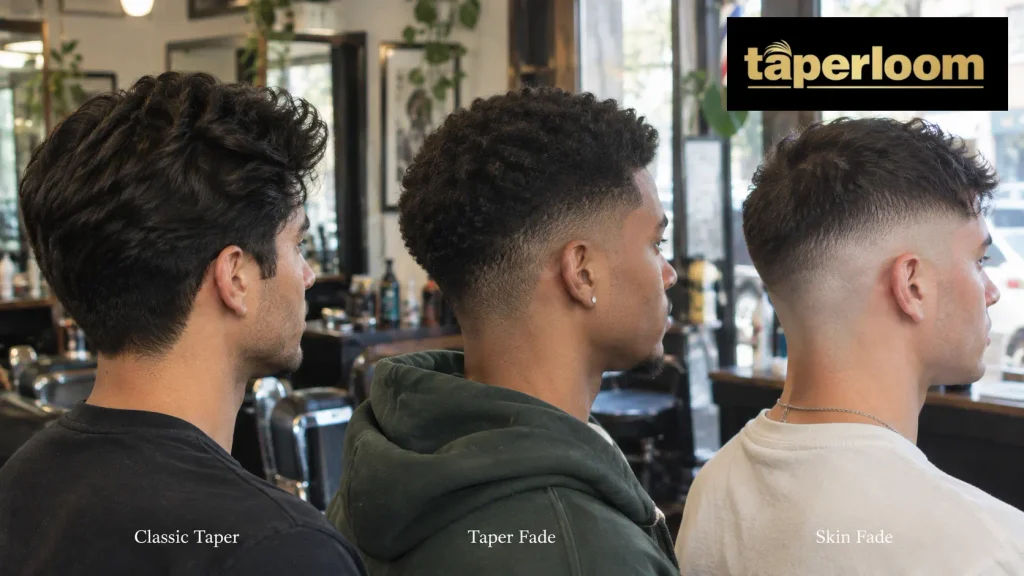
A classic taper keeps hair at the neckline and sideburns instead of removing it. A fade takes it all the way to the skin, blending from the Side Hair down to nothing. A taper fade sits in between, it keeps the taper’s structure on top and blends the last inch or two into a fade near the edges.
| Feature | Classic Taper | Taper Fade | Skin Fade |
| Hairline preserved | Yes | Partially | No |
| Lowest hair length | 1/8 in, #1 guard | Very short or skin | Shaved to skin |
| Maintenance | Every 4 to 6 weeks | Every 3 to 4 weeks | Every 2 to 3 weeks |
| Formality | High | Medium | Casual |
| Technique | Scissors and clippers | Clippers | Clippers and razor |
| Grow out | Graceful | Visible after 3 weeks | Loses shape fast |
| Best for | Corporate, formal | Everyday, modern | Fashion forward |
What is a classic taper fade?
A classic taper fade combines the classic taper’s longer top and gradual sides with a fade finish right at the neckline and lower sideburns. Most of the taper stays traditional.
Only the last inch or two near the edges goes short enough to look like a fade. Ask for it by saying, “a classic taper with a low fade finish at the neckline.”
Should I get a taper or a fade?
Get a taper if you want a cut that holds its shape longer, needs fewer barbershop visits, and works in conservative settings like law, finance, or government.
Get a fade if you want sharper contrast and don’t mind visiting the barber every 2 to 3 weeks to keep the line clean.
Classic Taper vs Undercut vs Crew Cut vs Ivy League
These four cuts get confused constantly because they all pair short sides with longer hair on top. The real differences come down to how short the sides go and where the length sits.
| Feature | Classic Taper | Undercut | Crew Cut | Ivy League |
| Side length | Gradual taper, no skin | Very short, disconnected line | Short, tapered | Short, tapered |
| Top length | 2 to 4 in | 3 to 6+ in | 1 to 2 in | 1.5 to 2.5 in |
| Blend style | Smooth, no visible line | Hard line, disconnected | Smooth | Smooth |
| Formality | High | Low to medium | High | High |
| Best for | All purpose, professional | Fashion forward, styled looks | Military, active lifestyles | Preppy, collegiate look |
Low vs Mid vs High Classic Taper, Which Should You Get?
A low taper starts near the ear and keeps most of your hair. A mid taper starts at the side hairline for a balanced look. A high taper starts above theside hairline and creates the most contrast with the top. All three keep the same rule, no skin ever shows.
| Taper height | Starts at | Contrast level | Best job fit | Maintenance |
| Low | Ear level | Subtle | Law, finance, government | Every 5 to 6 weeks |
| Mid | side hairline | Balanced | Everyday, creative work | Every 4 to 5 weeks |
| High | Above side hairline | Bold | Younger, fashion forward roles | Every 3 to 4 weeks |
Classic low taper
A low taper is the most conservative version. The graduation stays near the base of the neck and above the ears, so from a few feet away the cut barely looks tapered at all. It’s the safest choice if you work somewhere formal or you just don’t want people noticing you got a haircut.
Classic mid taper
A mid taper starts at the temple and gives you a cleaner, more defined look without going bold. It’s the middle ground most guys land on because it works for the office on Monday and looks sharp on a Friday night without any changes.
Classic high taper
A high taper starts above the temple, right around the crown area, and creates real contrast between the long top and short sides. It reads as more modern and needs more frequent trims to stay sharp, but it’s still a taper underneath, no skin exposed.
Which taper height lasts the longest?
A low taper lasts the longest, typically 5 to 6 weeks, because there’s more hair length at every point on the sides before it starts looking grown out. A high taper needs a refresh every 3 to 4 weeks since the shorter zones grow out and blur the contrast faster.
Best Classic Taper for Your Face Shape
| Face shape | Best style | Avoid |
| Oval | Any variation | Nothing, all styles work |
| Round | High taper, textured top | Low taper, flat top |
| Square | Low taper, soft texture | Hard part, high taper |
| Diamond | Low to mid taper, side part | High taper |
| Heart | Low taper, crown volume | Heavy pompadour |
| Oblong | Low taper, flat or textured top | Tall pompadour or quiff |
Classic taper for an oval face
Oval is the most balanced face shape, so almost every taper height and top style works here. If you’re oval, pick based on what you want to wear, not what you need to correct.
Classic taper for a round face
A high taper with a textured or slightly voluminous top adds visual height and trims the width on the sides, which keeps a round face from looking wider than it is.
Classic taper for a square face
Square faces already have strong angles, so a low taper with soft texture on top avoids adding more sharpness. Skip hard parts and high contrast here.
Classic taper for a diamond face
Diamond faces are narrow at the forehead and chin with wider cheekbones. A side part adds width up top, and a low to mid taper keeps the cheekbones balanced instead of emphasized.
Classic taper for a heart shaped face
Keep volume at the crown, not the temples, since a heart shaped face already has width up top. A low taper avoids adding more.
Classic taper for an oblong face
Oblong faces need width, not more height. A low taper with a flat or textured top keeps the silhouette horizontal instead of stretching the face longer.
Best Classic Taper for Your Hair Type
Classic taper for straight hair
Straight hair shows the taper’s clean lines better than any other texture, which is why it pairs so well with side parts and slicked back finishes. Use a pomade for shine or a matte paste if you want a more natural look.
Classic taper for wavy hair
The taper removes bulk on the sides while your natural wave pattern stays visible on top. A light sea salt spray or styling cream brings out the movement without weighing it down.
Classic taper for curly hair
Curly hair benefits the most from a taper because the tight sides stop curls from ballooning into a mushroom shape. Ask for a point cut on top to keep the curls full without cutting away the length.
Classic taper for coily hair, 3C to 4C
Coily hair needs a barber who’s actually experienced with tight curl patterns, since the blending technique is different from straight or wavy hair.
Done right, the taper controls volume on the sides while your natural texture, twists, or waves stay untouched on top. If you want more coverage on this, our guide to a low taper fade afro breaks down every texture in detail.
Classic taper for thick hair
Thick hair tends to look puffy on the sides if it’s just clipped and left alone. Ask for thinning shears or a point cut to remove weight without losing length.
Classic taper for fine or thin hair
Keep the sides short and the top slightly longer so the contrast makes your hair read as fuller than it is. A volumizing mousse or texture powder at the roots helps too.
Does a classic taper work with a receding hairline?
Yes, and it’s actually one of the better options. A classic taper doesn’t create a hard line anywhere near the front hairline the way some undercuts do, so there’s nothing drawing attention to where your hair is thinning.
Keep the top slightly shorter, around 1.5 to 2 inches, and ask your barber to soften the taper near the temples rather than sharpening it.
65 Classic Taper Haircut Styles
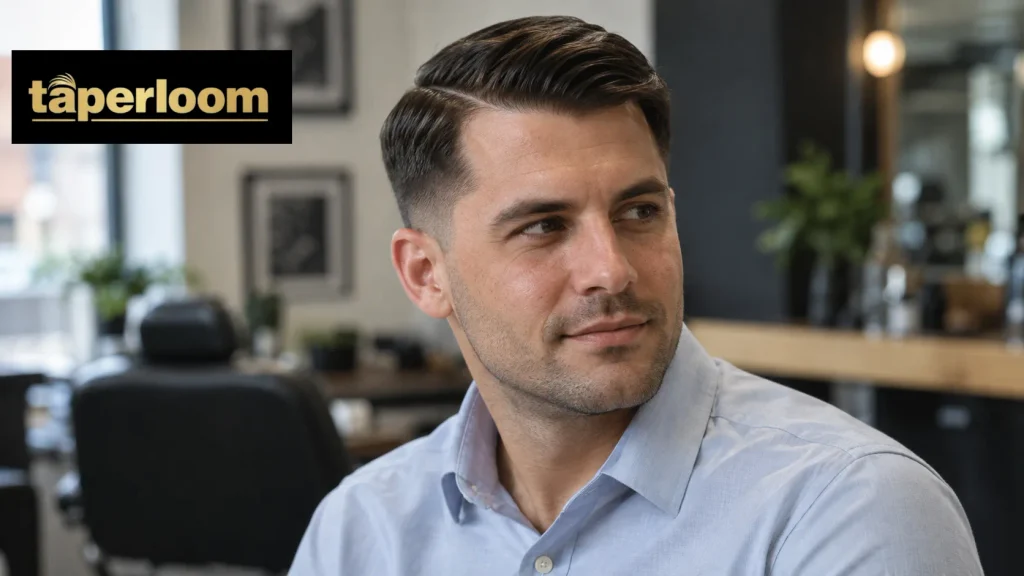
Low Classic Taper Styles
The Executive Low Taper
Short and neat on top, around 2 inches, with a low taper on the sides. This is the safest business haircut there is, and it works in literally any office. Ask your barber for: 2 inches on top, low taper, natural neckline. Best for: Fine to medium hair, oval and square faces.
Low Taper with Side Part
A clean comb line and a glossy pomade finish give this the classic gentleman look. Simple, sharp, and it never goes out of style. Ask your barber for: Low taper, side part cut in with scissors, medium shine finish. Best for: Straight hair, oval and diamond faces.
Low Taper Comb Over
Your hair gets combed to one side for extra fullness on top, which makes this a good pick if your hair is fine or your hairline is starting to move back. Ask your barber for: Low taper, 2.5 inches on top, comb over direction. Best for: Fine hair, receding hairlines.
Low Taper Slicked Back
Hair combed straight back with a high shine pomade. It’s formal, it’s polished, and it works for anything from a Tuesday meeting to a wedding. Ask your barber for: Low taper, 3 inches on top, slick back with pomade. Best for: Straight or wavy hair, oval faces.
Low Taper for Thick Hair
Point cutting or thinning shears remove bulk on top while the low taper keeps the sides tight and controlled underneath. Ask your barber for: Low taper, point cut on top, thinning shears. Best for: Thick hair, square faces.
Low Taper Ivy League
A short, preppy cut where the front sits slightly longer than the back. Clean, collegiate, and easy to maintain. Ask your barber for: Low taper, Ivy League top, 1.5 to 2 inches. Best for: Straight hair, oval and square faces.
Low Taper with Natural Texture
Minimal product, air dried, matte finish. It’s professional without looking like you tried too hard. Ask your barber for: Low taper, textured top, matte finish. Best for: Wavy hair, all face shapes.
Low Taper with Beard
The sideburns blend right into a shaped beard for one continuous line from your hair down to your jaw. Ask your barber for: Low taper, sideburns blended into beard. Best for: All hair types, square and oval faces.
Low Taper Hard Part
A shaved line defines the part on an otherwise conservative cut, adding just a bit of edge without going bold anywhere else. Ask your barber for: Low taper, hard part line, 2 inches on top. Best for: Straight hair, oval faces.
Low Taper Textured Crop
Short, slightly messy on top, easy to style with just your fingers and a bit of paste. Ask your barber for: Low taper, textured crop, 1.5 to 2 inches. Best for: Wavy or curly hair, most face shapes.
Low Taper Brush Up
Hair brushed straight up and forward for a subtle lift without much length needed on top. Ask your barber for: Low taper, brush up styling, 2 inches on top. Best for: Straight to wavy hair, round and oval faces.
Low Taper Classic Side Sweep
A longer, softer version of the side part where the hair sweeps rather than sits rigidly combed. Ask your barber for: Low taper, 2.5 to 3 inches, side sweep finish. Best for: Wavy hair, heart and oval faces.
Mid Classic Taper Styles
Mid Taper Textured Top
Natural movement on top, styled with matte clay for a lived in look that still reads as put together. Ask your barber for: Mid taper, textured top, matte clay finish. Best for: Wavy hair, most face shapes.
Mid Taper Textured Crop
Short and slightly messy, casual enough for every day but still clean at the sides. Ask your barber for: Mid taper, textured crop, 1.5 to 2 inches. Best for: Thick or wavy hair, square faces.
Mid Taper Pompadour
Volume swept up and back. It takes a blow dryer and a strong hold pomade to get right, but the payoff is worth it. Ask your barber for: Mid taper, 3.5 to 4 inches on top, pompadour set. Best for: Thick or straight hair, oval and square faces.
Mid Taper Quiff
A shorter, less dramatic cousin of the pompadour that still gives you height at the front. Ask your barber for: Mid taper, 3 inches on top, quiff styling. Best for: Wavy or thick hair, round and oval faces.
Mid Taper Messy Quiff
Styled but not overworked, using texture paste and just your fingers to set it. Ask your barber for: Mid taper, messy quiff, texture paste finish. Best for: Wavy hair, most face shapes.
Mid Taper Natural Curls
Curly hair left full on top while tight sides keep the volume in check. Ask your barber for: Mid taper, natural curls preserved on top. Best for: Curly hair, oval and square faces.
Mid Taper Slick Back
Longer on top, around 3 to 4 inches, combed straight back for a natural or glossy finish depending on the product. Ask your barber for: Mid taper, 3 to 4 inches, slick back. Best for: Straight hair, oval faces.
Mid Taper for Wavy Hair
Wavy texture left visible on top with sea salt spray, tapered sides for structure underneath. Ask your barber for: Mid taper, wavy top, sea salt spray finish. Best for: Wavy hair, all face shapes.
Mid Taper French Crop
Short, horizontal fringe with a textured finish. It’s modern and a little European in feel. If you want more ideas along these lines, check out our textured fringe mid taper guide. Ask your barber for: Mid taper, French crop fringe, textured finish. Best for: Straight to wavy hair, oval and diamond faces.
Mid Taper Two Block
A distinct separation between a longer top and short sides, popular in Korean and Japanese men’s styling. Ask your barber for: Mid taper, two block separation, 3 inches on top. Best for: Straight hair, oval and round faces.
Mid Taper Side Part
A slightly more relaxed version of the low taper side part, with more contrast on the sides. Ask your barber for: Mid taper, side part, medium shine. Best for: Straight hair, oval and square faces.
Mid Taper Brushed Back
Hair brushed back with texture rather than slicked flat, giving a softer finish than the slick back version. Ask your barber for: Mid taper, brushed back, light hold paste. Best for: Wavy hair, heart and oval faces.
High Classic Taper Styles
High Taper Crew Cut
Very short on top with a high taper underneath. Clean, low maintenance, and a little military inspired. Ask your barber for: High taper, crew cut top, 1 to 1.5 inches. Best for: All hair types, square and oval faces.
High Taper Flat Top
Hair on top cut flat and styled to stand upright. Bold, retro, and hard to miss. Ask your barber for: High taper, flat top styling. Best for: Thick hair, square and round faces.
High Taper Textured Spikes
Short spiky hair on top with a high taper for sharp contrast underneath. Ask your barber for: High taper, textured spikes, matte clay. Best for: Straight to wavy hair, oval faces.
High Taper for Curly Hair
Curls stay full and voluminous on top while the high taper keeps the sides extremely clean. Ask your barber for: High taper, curls preserved on top. Best for: Curly hair, oval and diamond faces.
High Taper Faux Hawk
Hair styled upward through the center for a subtle mohawk effect without going full mohawk. Ask your barber for: High taper, faux hawk styling. Best for: Straight to wavy hair, oval and round faces.
High Taper Undercut Blend
The taper sits high enough to look like an undercut but stays blended, no disconnected line. Ask your barber for: High taper, undercut height, fully blended. Best for: Straight hair, most face shapes.
High Taper Textured Top
Natural texture left on top with a strong contrast underneath from the high taper. Ask your barber for: High taper, natural texture, matte finish. Best for: Wavy hair, oval faces.
High Taper Pompadour
Maximum contrast between the volume on top and the tight sides below. Ask your barber for: High taper, pompadour set, strong hold. Best for: Thick hair, square and oval faces.
High Taper Slick Back
A bolder version of the slick back with more contrast at the sides than the low or mid versions. Ask your barber for: High taper, slick back, high shine pomade. Best for: Straight hair, oval faces.
High Taper Side Swept
Hair swept to one side with more edge than a traditional side part thanks to the high contrast underneath. Ask your barber for: High taper, side swept top, light hold. Best for: Wavy hair, round and oval faces.
Short Classic Taper Styles
Buzz Cut Taper
The whole head buzzed short with a tapered neckline for a bit of polish at the bottom. For more length and guard options, see our full buzz cut breakdown. Ask your barber for: #3 guard on top, tapered neckline, no hard line. Best for: All hair types, all face shapes.
Crew Cut Taper
Slightly longer up front, tapered on the sides. The classic American cut. Ask your barber for: Crew cut top, taper on sides, 1 to 1.5 inches. Best for: Thick or straight hair, square faces.
Butch Cut Taper
Extremely short and uniform on top with a subtle taper for definition at the sides. Ask your barber for: Butch cut, subtle taper, #2 guard. Best for: All hair types, oval and round faces.
Short Taper with Hard Part
A shaved line creates a defined part on a very short top. Ask your barber for: Short taper, hard part, #3 guard on top. Best for: Straight hair, oval faces.
Short Corner Taper
A clean, tight taper that finishes right around the sideburn corner for a sharp, no fuss look. Ask your barber for: Corner taper, tight blend, 1.5 inches on top. Best for: All hair types, square faces.
Short Taper with Natural Texture
Air dried and product free, this is the lowest maintenance version of the short taper. Ask your barber for: Short taper, natural texture, no product finish. Best for: Wavy hair, most face shapes.
Short Taper Brush Forward
Hair brushed slightly forward on top for a youthful, casual finish. Ask your barber for: Short taper, brush forward styling. Best for: Straight hair, oval and round faces.
Short Scissor Taper
Done entirely with scissors rather than clippers for a softer, more textured finish on top. Ask your barber for: Scissor cut taper, no clipper on top. Best for: Thick hair, square and oval faces.
Long Classic Taper Styles
Long Slicked Back Taper
Hair combed straight back with pomade or cream. Elegant and timeless. Ask your barber for: Low or mid taper, 4 to 5 inches on top, slick back. Best for: Straight hair, oval faces.
Long Comb Back Taper
Similar to the slicked back version but with less shine and more natural movement. Ask your barber for: Mid taper, 4 inches on top, comb back with cream. Best for: Wavy hair, oval and heart faces.
Long Side Part Taper
A classic side part with enough length on top for a dramatic sweep. Ask your barber for: Low taper, 4 to 5 inches, deep side part. Best for: Straight hair, oval and diamond faces.
Long Pompadour Taper
High volume pompadour on top paired with clean tapered sides for maximum impact. Ask your barber for: Mid taper, 4 to 5 inches, pompadour set. Best for: Thick hair, square and oval faces.
Long Flow Taper
Hair flows naturally backward and to the side, which works especially well with wavy texture. Ask your barber for: Mid taper, 4 inches, natural flow styling. Best for: Wavy hair, oval and round faces.
Long Wavy Taper
Natural waves left on top with clean sides underneath, styled with sea salt spray or a light cream. Ask your barber for: Low taper, 4 inches, waves left natural. Best for: Wavy hair, all face shapes.
Long Textured Fringe Taper
A long fringe pushed forward or to the side, with tapered back and sides for contrast. Ask your barber for: Mid taper, long textured fringe. Best for: Straight to wavy hair, oval and diamond faces.
Long Brushed Up Taper
Hair brushed up and back for volume, with tapered sides doing the heavy lifting to keep it controlled. Ask your barber for: Mid taper, 4 to 5 inches, brushed up finish. Best for: Thick or wavy hair, square faces.
Classic Taper with Beard Blend
Low Taper with Full Beard
Clean taper on the sides with a shaped, full beard where the sideburns blend seamlessly into it. Ask your barber for: Low taper, sideburns blended into full beard. Best for: All hair types, square and oval faces.
Mid Taper with Short Stubble
Casual and easy to maintain, with the stubble kept at a consistent length across the jaw. Ask your barber for: Mid taper, short stubble blend. Best for: Straight to wavy hair, oval faces.
High Taper with Shaped Beard
High contrast on top paired with a sharp, defined beard line for a bold overall look. Ask your barber for: High taper, shaped beard with defined line. Best for: Thick hair, square faces.
Corner Taper with Beard Fade
The taper finishes at the sideburn corner and fades directly into the beard for one continuous transition. Ask your barber for: Corner taper, beard fade blend. Best for: All hair types, most face shapes.
Low Taper with Goatee
A more understated pairing where the taper stays conservative and the goatee does the styling work. Ask your barber for: Low taper, goatee kept separate from sideburns. Best for: Straight hair, oval and diamond faces.
Mid Taper with Full Beard and Mustache
A fuller, more rugged combination where the beard and mustache connect cleanly to the sideburns. Ask your barber for: Mid taper, full beard and mustache blend. Best for: Thick hair, square and round faces.
Classic Taper for Textured and Coily Hair
Classic Taper with Afro Top
A full afro on top with clean tapered sides, letting the taper control volume while the top stays completely natural. Ask your barber for: Low or mid taper, afro left natural on top. Best for: Coily hair, 4A to 4C, oval and square faces.
Classic Taper with High Top
A tall, flat top paired with tapered sides for a bold, retro finish. Ask your barber for: High taper, flat high top styling. Best for: Coily hair, square faces.
Classic Taper with Waves
Brushed in 360 waves on top with a low or mid taper on the sides for clean structure underneath. Ask your barber for: Low or mid taper, waves brushed in. Best for: Coily to curly hair, oval faces.
Classic Taper with Twist Out
Natural twists left on top with a clean taper on the sides for definition and structure. Ask your barber for: Mid taper, twist out preserved on top. Best for: Coily hair, most face shapes.
Classic Taper with Short Locs
Short locs on top paired with tapered sides for a modern, clean overall look. Ask your barber for: Low taper, locs left untouched on top. Best for: Coily hair, oval and square faces.
Classic Taper with Cornrows
Braided top with a low taper fade at the sides. Clean, protective, and stylish. Ask your barber for: Low taper fade, cornrows left as is. Best for: Coily hair, oval faces.
Classic Taper with Long Braids
Longer braids on top with tight tapered sides for contrast underneath. Ask your barber for: Low taper, tight sides, braids untouched. Best for: Coily hair, most face shapes.
Corner Taper for Black Men
A variation where the taper focuses specifically on the temples, popular in Black barbershop culture. For more styles built specifically for this hair type, see our mid taper fade styles for Black men guide.
Classic Taper with Natural Curls, 4A to 4B
Natural curl pattern kept full and defined on top with tight, clean sides underneath. Ask your barber for: Mid taper, curl definition cream on top. Best for: Coily hair, oval and diamond faces.
What to Tell Your Barber for a Classic Taper
A reference photo is always the safest bet, but if you want to use words, follow this five step script and you’ll get exactly what you’re after.
Say the style name. “I’d like a classic taper, please,” or “a regular taper” works just as well.
Give a top length. “Leave about [X] inches on top.” Two to 2.5 inches for business, 2.5 to 3 for a medium style, 3 to 4 for something longer.
Pick a taper position. “I’d like a low, mid, or high taper on the sides.” Low starts at the ear, mid starts at the temple, high starts above it.
Confirm the neckline. Say “tapered neckline, please” for a natural, feathered finish. Only say “squared” if you actually want a hard line.
Show a photo. Even one reference image removes almost all the guesswork.
Copy this and show your barber: “I’d like a classic taper. Leave [X] inches on top, with a [low/mid/high] taper on the sides. I’d like a natural, tapered neckline, not squared off.”
| Guard | Inches | Millimeters | Zone | Effect |
| #4 | 1/2 in | 12.7 mm | Upper sides | Longest side length |
| #3 | 3/8 in | 9.5 mm | Upper mid sides | Full side length start |
| #2 | 1/4 in | 6.4 mm | Mid sides | Transition zone |
| #1 | 1/8 in | 3.2 mm | Lower sides | Lower blend |
| #0.5 | 1/16 in | 1.6 mm | Neckline, sideburns | Final close taper |
Each guard number roughly represents an eighth of an inch of hair length. Knowing this scale means you can describe exactly what you want to any barber, anywhere, even if they use a different brand of clippers.
What not to say at the barbershop
“Just take some off the top.” Too vague. Give an actual number in inches. “Surprise me.” Barbers aren’t mind readers, and you might not love the surprise.
“A little shorter than last time.” Only works if the same barber remembers your last cut. Give a real length instead.
“Whatever’s easy for you.” This usually gets you the barber’s default cut, not yours. “Make it clean.” Clean means different things to different people. Say tapered or faded specifically.
Tapered vs blocked vs rounded neckline
A tapered neckline fades gradually with no visible line, the most natural and versatile option. A blocked neckline is cut straight across for a sharp, defined edge, common in barbershop culture and Black hairstyling. A rounded neckline follows the natural curve of your head for a softer finish that some men find grows out better.
How a Barber Cuts a Classic Taper
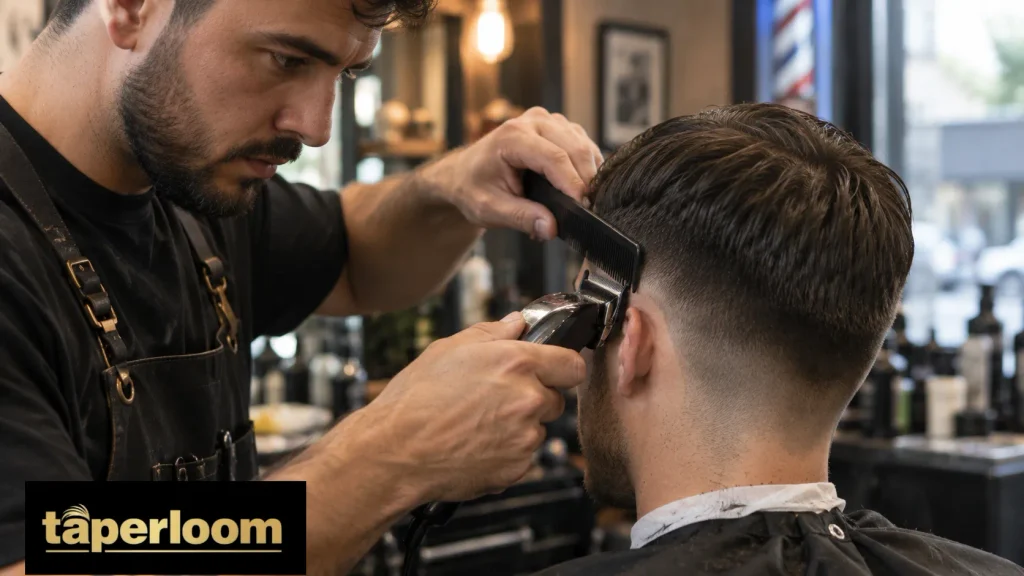
Understanding the actual technique helps you communicate better in the chair, even if you’re not the one holding the clippers.
Clipper over comb, the barber combs hair up and cuts what sticks through the teeth, used for precise blending on top and at the crown.
Scissor over comb, the same idea but with scissors instead of clippers, giving a softer, less mechanical finish, especially on top. Guide over comb, clippers run along the comb itself as a guide, common for creating the gradual taper on the sides.
Lever play, adjusting the clipper’s built in lever mid cut to shift between guard lengths without swapping attachments, which is how barbers create that seamless graduation instead of visible steps.
The 7 step process: section the hair into top, sides, and back, establish the neckline first with clippers or a straight razor, taper the lower sides with the shortest guard working up, blend the mid sides with lever play or guard changes, connect the upper sides into the top length using clipper over comb, cut the top to the requested length with scissors, then do a final blend check and style with product.
Can You Do a Classic Taper at Home?
Partly. You can maintain the neckline and sideburns between visits, but the upper blend takes a trained hand and the right tools. Don’t try to recreate the whole cut yourself.
Tools you’ll need: a small trimmer, Wahl, Andis, or similar, a handheld mirror, and a fine tooth comb.
The 6 step neckline touch up: wash and dry your hair first, never trim it wet. Set your trimmer to a #1 or #0.5 guard. Follow your existing neckline shape, don’t try to reshape it.
Work in short, light strokes rather than one long pass. Clean up any sideburn growth past the ear. Leave the upper taper area completely alone, that’s your barber’s job.
How to Style a Classic Taper
Styling a short top, 1 to 2 inches
Apply a small amount of matte clay or paste to damp hair and work it through with your fingers. There’s not much to direct here, so keep it simple and don’t overload with product.
Styling a medium top, 2 to 3 inches
This is where a side part or textured finish really shines. Use a fine tooth comb for a crisp part, or your fingers with a light paste for a more relaxed, textured look.
Styling a long top, 3 to 5 inches
Longer tops need more hold to stay in place all day. Blow dry with a round brush for volume styles like a pompadour or quiff, or use a strong hold pomade for a slicked back finish.
| Look | Product type | Hold level | Best for |
| Matte, natural | Matte clay or paste | Medium to high | Business settings |
| Glossy, sleek | Water based pomade | High | Side parts, slick backs |
| Textured, casual | Sea salt spray and paste | Light to medium | Wavy hair, relaxed looks |
| Extra volume | Volumizing mousse | Light | Fine hair, pompadours |
| All day hold | Hair wax | Very high | Thick hair, long tops |
Three quick styling routines. 60 second matte finish, dime sized clay, work through damp hair, comb once, done. 60 second slick back, pomade warmed between palms, comb straight back from front to crown, done.
60 second textured look, sea salt spray on damp hair, scrunch with fingers, air dry or diffuse, done.
Maintenance, Grow Out and Cost
| Style | Barbershop frequency | Daily styling time | Difficulty |
| Classic taper | Every 4 to 6 weeks | 2 to 5 minutes | Easy |
| Taper fade | Every 3 to 4 weeks | 3 to 7 minutes | Easy to moderate |
| Skin fade | Every 2 to 3 weeks | 1 to 3 minutes | Easy |
| Undercut | Every 3 to 4 weeks | 5 to 10 minutes | Moderate |
| Pompadour | Every 4 to 5 weeks | 10 to 15 minutes | High |
How long does a classic taper last?
A classic taper holds its shape for 4 to 6 weeks on average. After that the neckline starts to look slightly grown out, but it never looks messy the way a fade does once the line blurs.
Week by week grow out timeline
Week 1 to 2, the cut looks freshly done, all lines sharp and clean. Week 4, the sides have softened slightly but the taper is still clearly defined. Week 6, the neckline starts showing growth, though the overall shape still reads as intentional.
Week 8, the taper has mostly grown out into a natural, longer style, time for a fresh cut.
How much does a classic taper cost?
In the US, expect $20 to $35 at a standard barbershop and $40 to $60 at a premium or big city shop. In the UK, prices run roughly £15 to £35. In Australia, budget $25 to $50 AUD. Tipping 15 to 20 percent is standard in the US, though it’s less common or expected in the UK and Australia.
At home upkeep between visits
Trim your neckline lightly every 1 to 2 weeks using the 6 step method above. Clean up any sideburn hair that grows past your ear. Never touch the upper blend yourself, that’s the part that actually needs a barber.
7 Classic Taper Mistakes to Avoid
Not giving a specific length. “Short” means something different to everyone, give inches. Skipping the reference photo, words alone leave too much room for misunderstanding.
Getting it cut the day before a big event, fresh cuts can look stiff or too red around the edges, get it done 2 to 3 days ahead instead. Overwashing your hair, washing daily strips the natural oils that help a taper hold its shape, stick to 2 to 3 times a week.
Using too much product, a pea sized amount goes further than you think, overloading looks greasy, not styled. Ignoring beard blend if you have facial hair, a sharp taper next to an unshaped beard looks unfinished.
Waiting too long between cuts, letting it grow past 6 to 8 weeks means starting almost from scratch on your next visit.
Classic Taper by Age and Setting
Teens and school dress codes
A mid or low taper with a textured top satisfies most school dress codes while still looking current. Avoid anything with hard shaved lines if your school has strict grooming rules.
Job interviews and corporate settings
Stick to a low taper, 2 to 2.5 inches on top, styled with a matte finish. Get it cut 2 to 3 days before the interview, not the morning of.
Men over 50 with grey or thinning hair
A low taper with slightly more length on top adds the appearance of density, and grey hair actually reads as more sophisticated with this cut than with a fade.
Military and workplace grooming standards
Most regulations call for a shorter, tighter version closer to what’s described above as a regulation cut. Check your specific branch or company policy for exact length limits before your appointment.
Classic Taper Inspiration
The 1950s side part look, low taper, glossy pomade, sharp comb line, timeless, works at any age.
The modern matte crop, mid taper, short textured top, zero shine, clean but not overly polished.
The scissor cut gentleman, low taper done entirely with scissors on top, soft and natural rather than sharply defined.
The high contrast pompadour, high taper, tall volume on top, built for someone who wants to stand out.
The natural texture taper, any taper height, air dried top, minimal product, effortless by design.
Frequently Asked Questions
What is a classic taper haircut?
A classic taper haircut is a men’s style where hair gradually shortens from the top down to the sides and back, ending in a clean finish at the neckline and sideburns without ever exposing the skin.
What is the difference between a classic taper and a fade?
A classic taper keeps short hair at the neckline, around 1/8 inch, while a fade blends all the way down to the skin. A taper reads as more conservative, a fade as more modern.
Is a regular taper the same as a classic taper?
Yes. “Regular taper” is the older, informal name barbershops used before “classic taper” became common.
How often should I get a classic taper cut?
Every 4 to 6 weeks keeps it looking sharp. If you want it consistently fresh, aim for every 3 to 4 weeks instead.
What face shapes suit a classic taper?
All of them. The sides stay consistent for every face shape, and you adjust the top length or style to balance your specific features.
Is a classic taper good for curly hair?
Yes, it’s actually one of the best options for curly hair since it removes bulk on the sides and keeps curls full and controlled on top.
How do I ask my barber for a classic taper?
Say “I want a classic taper, low, mid, or high, keep about [X] inches on top, and give me a natural tapered neckline.” Bring a photo if you can.
What is a business classic taper?
A conservative version with a low taper, 2 to 2.5 inches on top, natural neckline, and a side part or simple combed finish. The safest choice for corporate settings.
Is a classic taper low maintenance?
Yes, one of the lowest maintenance cuts available since it grows out gracefully and only needs a barbershop visit every 4 to 6 weeks.
What’s the difference between a short and long classic taper?
A short taper keeps 1 to 2 inches on top, a long taper keeps 3 to 5 inches. Both use the same tapered sides underneath.
Can I do a classic taper at home?
You can maintain the neckline and sideburns yourself between visits, but the upper blend needs a trained barber.
How much does a classic taper cost?
Around $20 to $35 in the US at a standard shop, more at premium locations. Roughly £15 to £35 in the UK and $25 to $50 AUD in Australia.
Does a classic taper work with thin hair?
Yes. Keep the sides short and the top slightly longer so the contrast makes your hair look fuller.
What’s the difference between a classic taper and a regulation cut?
Both share the same taper structure, but a regulation cut is shorter and stricter, built for military or workplace grooming rules rather than personal style.
How long should I let my hair grow before getting a classic taper?
You don’t need much length at all. Even hair as short as half an inch can be shaped into a classic taper, though 2 inches or more on top gives you more styling options.
Does a classic taper suit a receding hairline?
Yes, since it doesn’t create any hard lines near the front hairline that would draw attention to thinning areas.
What products work best for a classic taper?
Matte clay or paste for a natural finish, pomade for shine and hold, or sea salt spray for texture on wavy hair.
Can women get a classic taper haircut?
The classic taper is typically a men’s cut, though the same tapering technique is used in some women’s short hairstyles under different names.
What’s the best classic taper for a job interview?
A low taper with 2 to 2.5 inches on top, styled with a matte product, cut 2 to 3 days before the interview.
How is a classic taper different from a crew cut?
A crew cut keeps the top very short, 1 to 2 inches, with a tighter overall profile. A classic taper allows for more length and styling flexibility on top while using the same tapered sides.
Classic Taper Haircut: Final Takeaway
The classic taper works because it never tries too hard. Keep the top long enough to style, taper the sides without touching skin, and get it refreshed every 4 to 6 weeks.
No skin exposure, ever, that’s what makes it a taper and not a fade. Low, mid, and high heights each fit a different job and personality. Every hair type and face shape has a version that works. One script gets you the right cut anywhere.
Not sure which taper fits you best? Browse more real barber guides on Taper Loom for every taper height, hair type, and style, including our low taper fade and high taper fade collections.
Read Next Burst Fade Design: 40+ Ideas, Placement Guide & Barber Tips (2026)

Muhammad Kaleem is a content creator who writes about hair care, hairstyles, grooming, and everyday hair trends. He enjoys turning hair-related topics into simple, practical, and easy-to-understand content that helps readers make informed choices about their hair and personal style.