
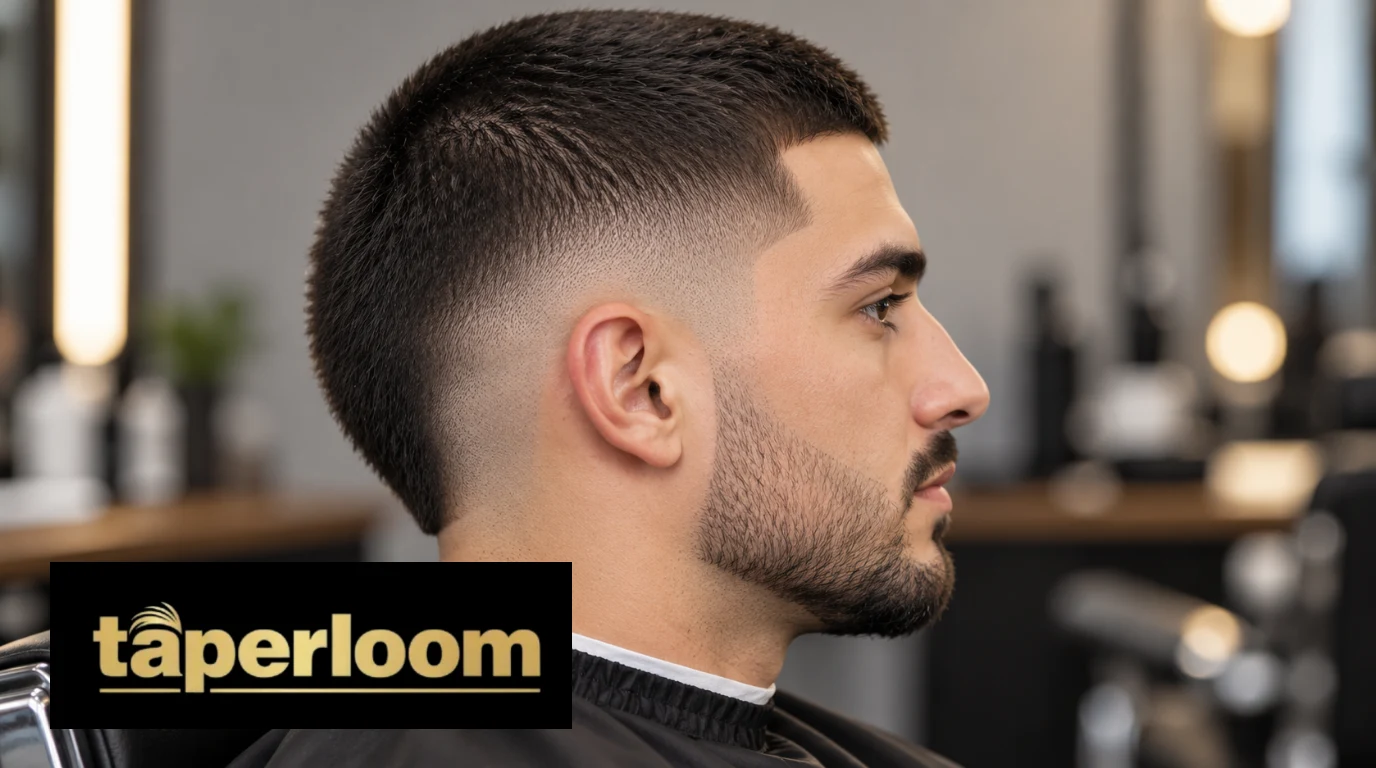
A burst fade buzz cut gives you the easiest kind of haircut with a little more shape. The top stays short and even, and the sides curve away around the ear in a semicircle. There is almost nothing to style, but the cut still looks deliberate.
This guide covers 33 variations, the guard numbers worth asking for, how to choose a fade height, what to say to your barber, how the cut is built, and how to keep it sharp. It also covers the things most guides skip, such as ingrown hairs, grow-out, receding hairlines and sun protection for a closely cropped scalp.
What Is a Burst Fade Buzz Cut?
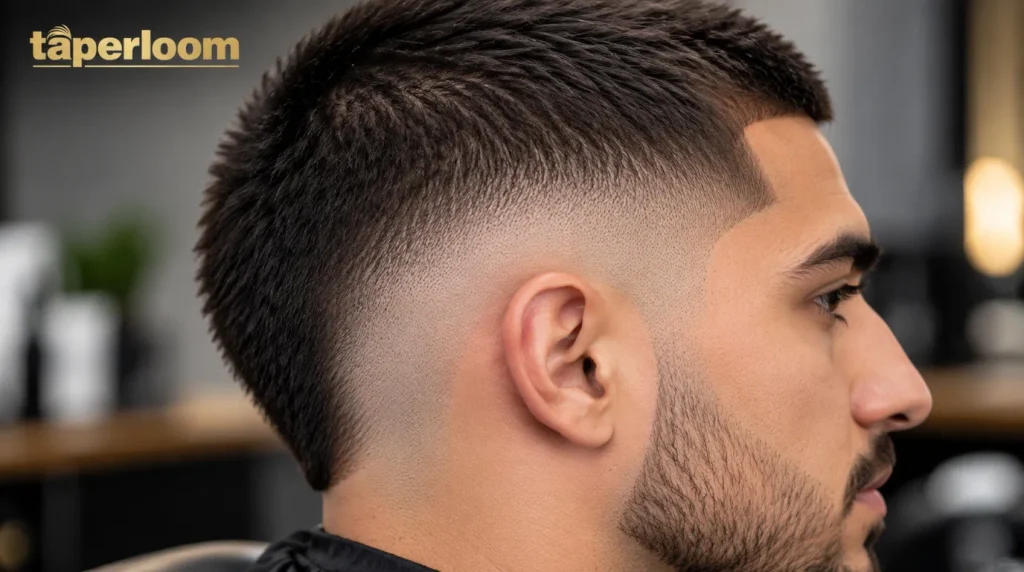
A burst fade buzz cut is a short haircut with an evenly clipped top and a rounded fade that wraps around the ear. The hair gets progressively shorter toward the skin around the ear and neckline. The result is a buzz cut with shape and contrast.
How the Burst Curve Works
A standard fade runs in a fairly straight line from the temple to the neckline. A burst fade follows the curve of the ear instead, so the shortest hair sits in an arc that looks like it radiates outward. That arc is the whole point. It softens the head’s outline and makes a plain buzz look tailored.
Key Features
- An even, short length on top, typically between a #1 and #4 guard.
- A semicircular fade around the ear.
- A tight finish at the hairline, sideburns and neckline.
- Very little styling, since there is little length to manage.
- Works on straight, wavy, curly, thick and thin hair, with some adjustments covered below.
Burst Fade vs Taper, Drop and Skin Fade
These terms describe different things, and people often mix them up.
| Term | What it describes |
| Burst fade | The shape: a curved fade around the ear |
| Taper | A gentler, shorter-reaching blend, mainly at the sideburns and neckline |
| Drop fade | A fade line that dips lower behind the ear |
| Skin fade | The finish: hair fades all the way to bare skin |
They can be combined. A “low drop burst skin fade” is one haircut. Describe the shape, the height and the finish separately and your barber will know exactly what you mean.
Why Men Choose a Burst Fade Buzz Cut

- It needs almost no morning effort.
- The buzzed top suits warm weather and active lifestyles.
- It works across many face shapes and hair types.
- It pairs well with a beard, a line up or a small design.
- It can look office-ready or edgy depending on fade height and finish.
The trade-off is upkeep. The fade is the first thing to blur, so this is a barber-visit haircut, not a once-a-quarter one.
33 Best Burst Fade Buzz Cut Styles
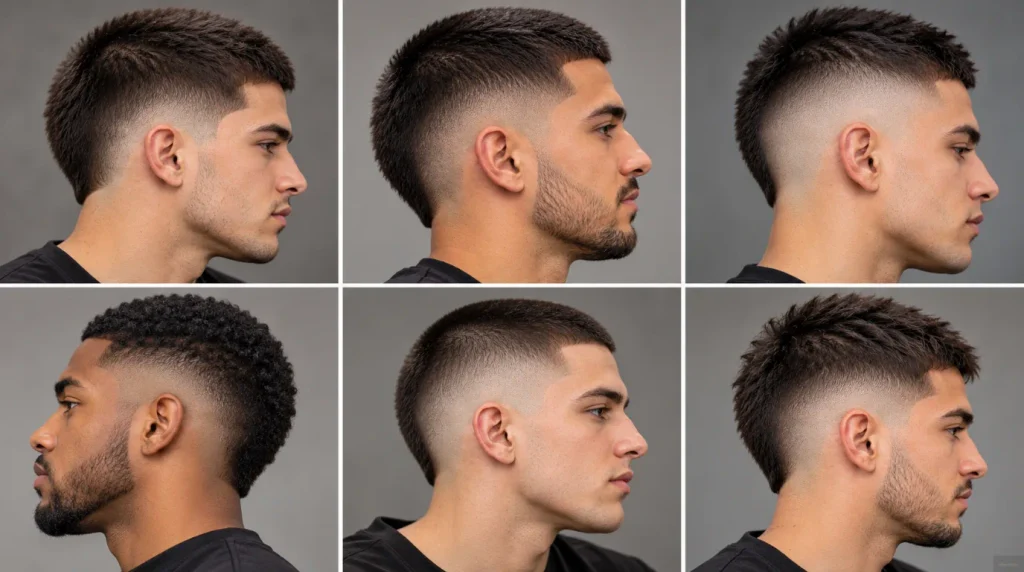
Several styles below overlap, and that’s intentional. Some differ by length, some by fade, some by an add-on. Each entry tells you what actually changes.
Fade height
1. Classic Burst Fade Buzz Cut
An even buzz with a traditional burst curve at mid height. It’s the safest starting point and suits nearly everyone.
2. Low Burst Fade Buzz Cut
The fade stays close to the ear and natural hairline. It’s subtle and conservative, and it needs the fewest touch-ups.
3. Mid Burst Fade Buzz Cut
The fade begins around the temple. It gives clear contrast without being dramatic, so it’s a good first request if you’re unsure.
4. High Burst Fade Buzz Cut
The fade starts high on the sides and blends quickly into the top. It gives the strongest contrast and removes the most bulk, but it grows out noticeably faster.
5. Burst Fade Buzz Cut with Sideburn Fade
The fade concentrates around the sideburns and the front of the ear, while the lower sides stay slightly longer. This keeps the contrast soft and frames the face without looking dramatic. It’s a good pick if you want a visible burst curve but prefer a more relaxed finish.
Fade finish and technique
6. Skin Burst Fade Buzz Cut
The fade goes down to bare skin. It’s the sharpest option and also the most demanding to maintain, and it shows every scalp mark.
7. Shadow Burst Fade Buzz Cut
Instead of skin, a faint shadow of hair stays at the base. It’s softer, grows out more gently and is easier on the skin.
8. Razor Burst Fade Buzz Cut
A straight razor or foil shaver finishes the lowest part of the fade for a crisp edge. Ask for it only if your skin tolerates close shaving (see the ingrown hair section below).
9. Taper Burst Fade Buzz Cut
Combines the burst curve with a gentle taper, keeping slightly more length at the neck. It’s a softer, more professional finish.
10. Drop Burst Fade Buzz Cut
The fade line drops behind the ear before curving back up. It adds depth at the back and can make the head shape look more defined.
Length variations on top
11. Induction Burst Fade Buzz Cut
The shortest option, with the top clipped almost to the scalp. It’s minimal and cool in summer, but it needs sunscreen.
12. Military Burst Fade Buzz Cut
A very short, uniform top and a tight burst fade. Its character is neat and disciplined rather than creative.
13. Burr Cut with Burst Fade
A short, single-guard length, usually around a #1 to #2, finished with a burst fade. It’s slightly fuller than an induction cut.
14. Butch Cut with Burst Fade
A slightly longer, even top. It reads fuller and more classic, and it suits men who want some hair without styling.
15. Short Burst Fade Buzz Cut
Everything stays tight and close, with the burst curve as the only detail. It’s the lowest-effort version.
16. Textured Burst Fade Buzz Cut
The top is left a bit longer and point-cut or lightly shaped for movement. It works well on thick or wavy hair that would otherwise look flat.
Add-ons and details
17. Buzz Cut with Line Up and Burst Fade
A crisp edge-up along the forehead and temples contrasts with the curved fade. It looks sharp, and it needs frequent touch-ups.
18. Buzz Cut with Beard and Burst Fade
The beard connects directly to the fade. See the beard section below for what suits which beard length.
19. Buzz Cut with Hair Design Burst Fade
A shaved line, shape or pattern is cut into the faded area. The simplest designs age best, and a busy one clashes with the burst curve.
20. Buzz Cut with Surgical Line Burst Fade
A single thin shaved line sits in the fade or eyebrow area. It’s a small accent with a big impact, and it’s easy to refresh.
21. Modern Burst Fade Buzz Cut
Clean lines, a tight fade and light texture. It’s a contemporary, balanced version.
22. Trendy Burst Fade Buzz Cut
Leans on current barbershop details, such as a hard part, a sharper line up or a design. Expect it to date faster than the classic.
23. Clean-Cut Professional Burst Fade Buzz Cut
A low-contrast fade with a neat top. It’s the best choice for conservative workplaces.
Hair-type versions
24. Curly Burst Fade Buzz Cut
Natural curls stay on top while the sides fade tight. The contrast shows off the curl pattern.
25. Wavy Burst Fade Buzz Cut
Short waves add movement on top while the fade keeps the sides controlled.
26. Straight Hair Burst Fade Buzz Cut
Straight hair lies flat, so the fade line is very visible. It’s neat with almost no effort, though any asymmetry also shows more.
27. Thick Hair Burst Fade Buzz Cut
The fade removes bulk from the sides so dense hair doesn’t flare out.
28. Thin Hair Burst Fade Buzz Cut
A short, even length reduces the contrast between thicker and thinner areas, so the hair looks more uniform.
Fashion crossovers
29. Buzz Cut Mullet with Burst Fade
Short top and sides with longer length at the nape, and a burst fade around the ears. Keep the back controlled to stay modern.
30. Buzz Cut Mohawk Burst Fade
The sides are cleared back to emphasize a central strip. It’s bold, and it needs regular upkeep to stay defined.
31. Buzz Cut Faux Hawk Burst Fade
A softer take with more length left at the sides, and slight height at the center.
32. Buzz Cut Edgar Burst Fade
A blunt, straight-across fringe is paired with the curved fade. The fringe needs frequent trims to stay straight.
33. Buzz Cut Crop Top Burst Fade
A slightly longer, textured crop on top with the burst on the sides. It’s the most styled-looking option in the “buzz” family.
Best Guard Numbers for a Burst Fade Buzz Cut
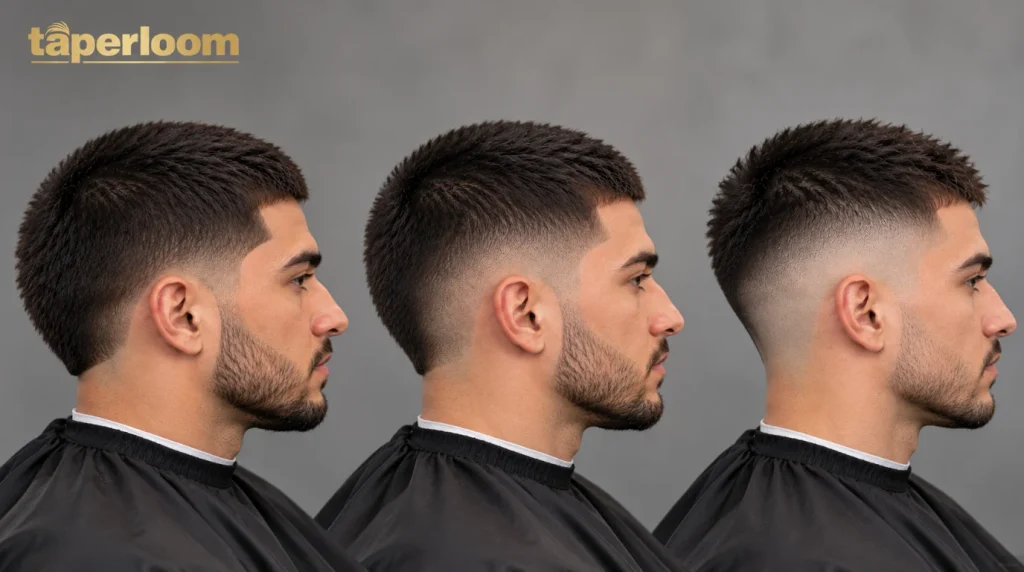
Guard numbers set the top length. Most standard clipper sets follow the same scale, though brands vary slightly, so confirm with your barber.
| Guard | Approx. length | Look |
| #0 | ~1.5 mm (1/16″) | Very close to the scalp |
| #1 | ~3 mm (1/8″) | Sharp and clean, a thin cover of hair |
| #2 | ~6 mm (1/4″) | Tidy, with a little more coverage |
| #3 | ~10 mm (3/8″) | Softer, shows natural texture |
| #4 | ~13 mm (1/2″) | Longest common buzz, light texture or a hint of a part |
#0 Buzz Cut
Maximum contrast against the fade and the lowest maintenance. It exposes everything on the scalp, so be sure you like your head shape and skin.
#1 Buzz Cut
Crisp and clean. It pairs well with a skin or tight burst for high contrast.
#2 Buzz Cut
A common safe choice. It looks neat, hides minor scalp variation and works with every fade height.
#3 Buzz Cut
A little extra coverage, and it suits men who find #1 or #2 too stark. It works well with a low or mid burst for a softer overall look.
#4 Buzz Cut
The longest common buzz length. It gives enough hair for texture and works well with a high fade for contrast.
A practical default is a #2 on top with the fade blending down to skin or a #0/#1 near the ear. Go one guard shorter on the sides than you think you need if you want the burst curve to stand out.
Low, Mid or High? Choosing Your Fade Height and Finish
Height decides how bold the cut looks:
- Low: subtle and professional, with the longest time between touch-ups.
- Mid: balanced contrast and a good default.
- High: strongest contrast and the cleanest silhouette, but it loses its edge fastest.
Finish decides how sharp and how demanding it is:
- Skin: maximum sharpness, and more skin care.
- Shadow: softer, more forgiving and easier to live with.
If you’re undecided, start with a mid burst and a shadow finish. You can go higher or tighter next time. It’s much harder to go back the other way.
How to Ask Your Barber for a Burst Fade Buzz Cut
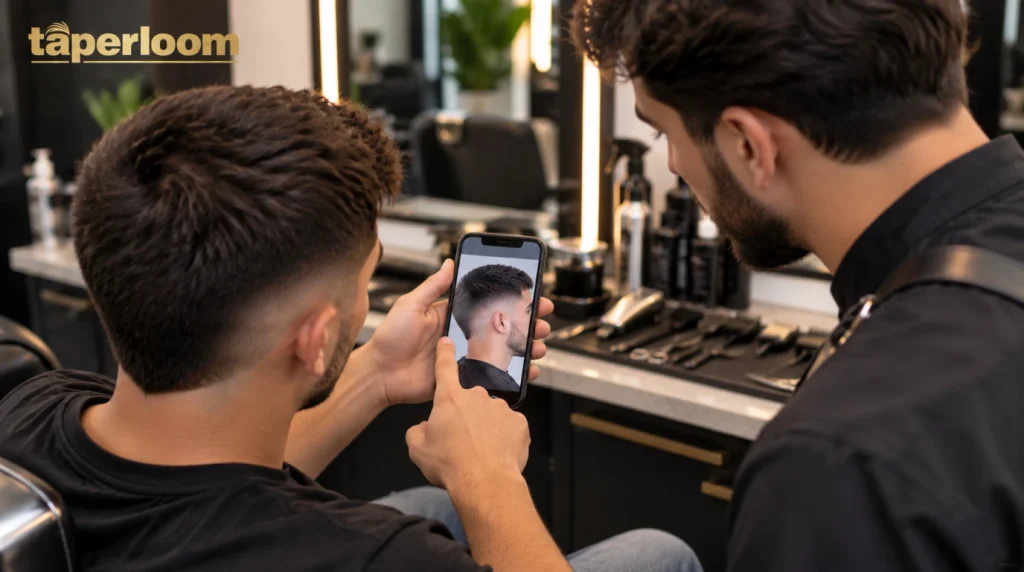
Script
“I’d like a [#2] buzz on top with a [mid] burst fade, curving around the ear, fading down to [skin/a shadow]. Clean up the neckline and sideburns [with/without] a line up.”
Bring a reference photo. Photos beat words because “burst” and “taper” mean slightly different things to different barbers.
Words to Avoid
- Don’t say only “a fade” or “a buzz with a taper” if you want the curve around the ear.
- Don’t say “short on the sides” without a guard number or finish.
Questions to Ask
- Will you use clipper-over-comb or a razor for the final blend?
- How soon will this need a touch-up at this height and finish?
- Can you leave the neckline slightly softer so it grows out better?
How a Burst Fade Buzz Cut Is Cut: 7 Steps
Step 1: Pick the Top Length
The guard number sets the overall look. See the table above.
Step 2: Set the Fade Height
Low, mid or high determines where the shortest hair starts.
Step 3: Cut the Curve Around the Ear
The barber follows the ear’s shape with the clippers, working from the shortest length near the ear outward. Keeping both sides equal is what makes it look intentional.
Step 4: Blend the Fade
Using clipper-over-comb and lever work, the barber removes hard lines between lengths so there are no visible steps from skin to buzz.
Step 5: Shape the Hairline
This is the edge up on the forehead, the line up along the temples, and the cleanup around the neckline and sideburns.
Step 6: Blend the Beard (Optional)
Sideburns taper into the beard so the haircut and facial hair read as one shape.
Step 7: Final Checks
The barber compares both sides in the mirror. Most burst fade buzz cuts need no product. A bit of moisturizer on a skin finish can help.
Best Face Shapes for a Burst Fade Buzz Cut
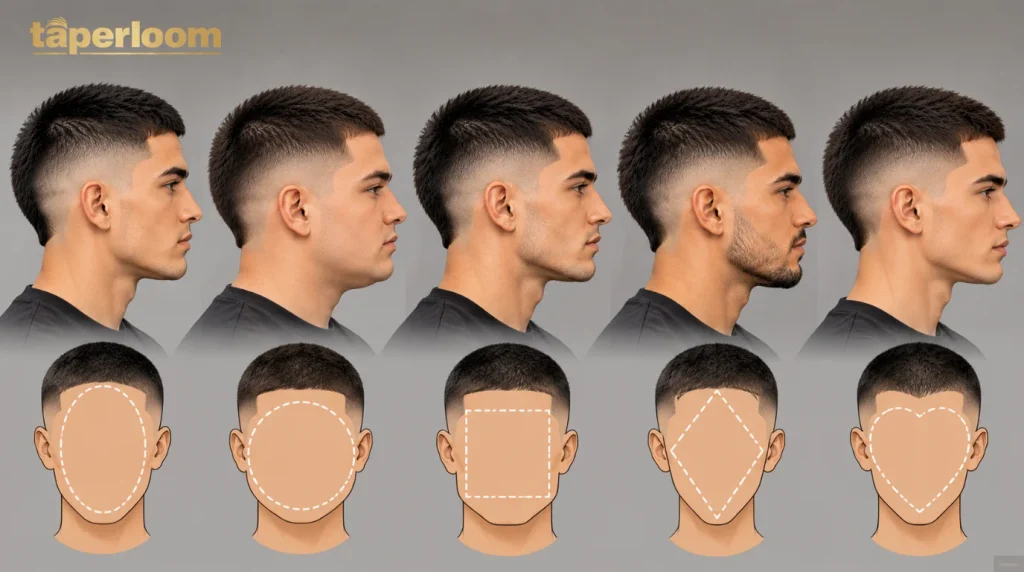
Face-shape advice is a guide, not a rule. The same haircut can look different depending on jaw, head shape and hairline.
Oval
Nearly every version works, so you can experiment with fade height and finish.
Round
A mid-to-high burst with a slightly longer top adds height and helps the face look longer.
Square
A low or mid burst softens strong jaw angles. A high burst emphasizes them, which some men like.
Diamond
A #3 or #4 top with a tight burst can balance a narrow forehead and jaw.
Heart
A low or mid burst keeps the sides from drawing extra attention to a wide forehead. Keep a bit of length on top to balance the chin.
Glasses and Ear Shape
The burst curve sits right where frame arms rest. A fade that’s too high can look busy with thick frames. Prominent ears are more visible with a high, tight fade, so a low or shadow burst is often more flattering.
Burst Fade Buzz Cut for Your Hair Type
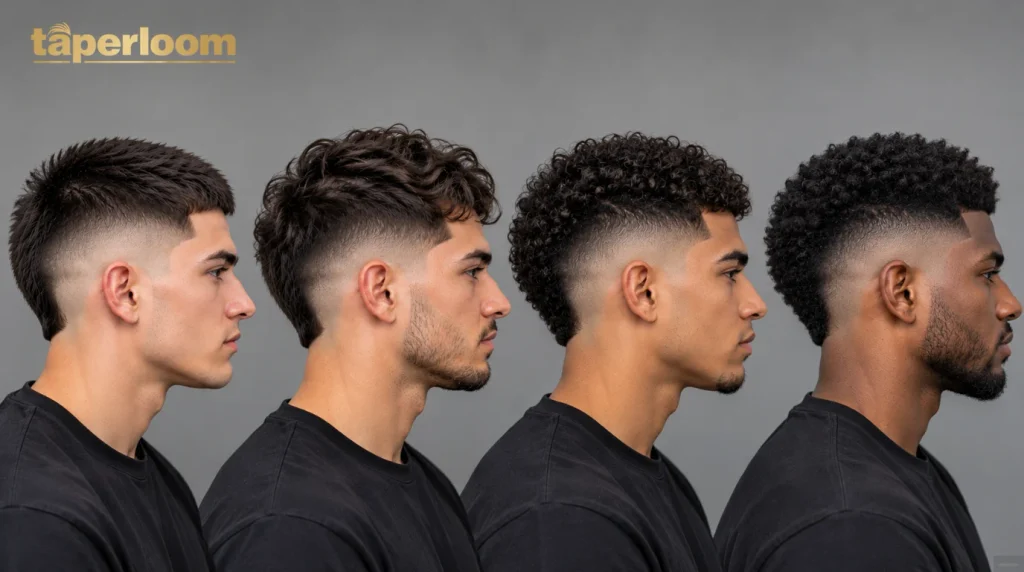
Straight
It lies flat and shows the fade line clearly, so symmetry matters.
Thick
The fade removes side bulk, and the top stays dense. A tight burst keeps the shape clean.
Thin
Keep the top even and short. A very high contrast fade can make thinning areas look more obvious, so a mid or low burst is often safer.
Wavy
A #3 or #4 top lets the waves show while the sides stay controlled.
Curly
Curl pattern on top contrasts sharply with the faded sides. Because tightly curled hair is more prone to ingrown hairs when cut very close, ask for a shadow or slightly longer finish.
Coily and Afro-Textured
A burst fade works especially well because the contrast is so clear. Plan scalp and ingrown-hair care carefully, and avoid a “baby smooth” finish unless your skin tolerates it.
Ingrown hairs can also occur when skin is pulled tight during a very close “baby smooth” cut, and curly hair raises the risk.
Read Also : Burst Fade Design: 40+ Ideas, Placement Guide & Barber Tips (2026)
Burst Fade Buzz Cut with a Beard
A beard and burst fade share one design goal: a clean, continuous shape.
- Short or stubble beard: the easiest pairing, with a nearly seamless blend.
- Short full beard or boxed beard: the cheek line and neckline should echo the curve of the fade.
- Long, untidy beard: this fights the fade’s clean lines.
Keep both the neckline and cheek line defined, and trim the beard in the same session as the haircut so the blend stays aligned. Beard oil or balm keeps the shape healthy.
Special Cases: Receding Hairline, Thinning Crown and Scars
- Receding hairline: a very short, even top makes recession look intentional. A sharp line up can make it more obvious, so a softer front is often better.
- Thinning crown: keep the length even and short, and avoid high contrast at the back.
- Scars or uneven scalp: a #0 or skin fade shows them. A #2 or #3 with a shadow finish hides more.
Burst Fade Buzz Cut vs Regular Buzz Cut
| Burst fade buzz cut | Regular buzz cut | |
| Look | Curved fade, more contrast and shape | One length all over, uniform |
| Maintenance | Touch-up about every 2 to 3 weeks | Can stretch to 4 to 6 weeks |
| Styling options | Fade height, finish, beard, designs | Mostly just guard length |
| DIY difficulty | Hard (curved blending) | Easy |
How to Maintain Your Burst Fade Buzz Cut
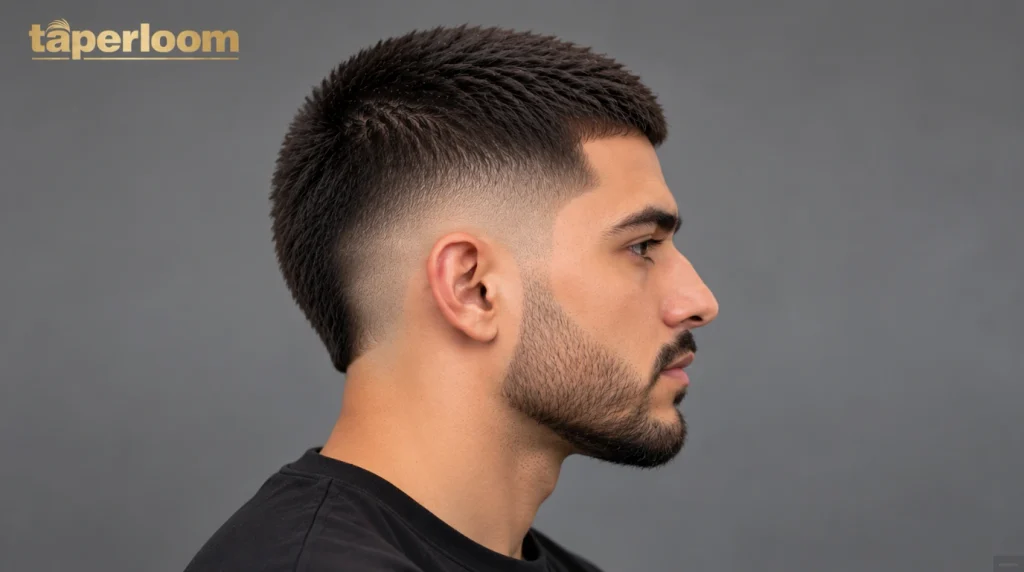
Trim Schedule
Most men refresh the fade every 2 to 3 weeks. The top can wait longer, but the faded sides show growth first, especially with a skin finish or high fade.
Grow-Out
Hair grows roughly half an inch a month on average, so a tight fade blurs within a few weeks. A low or shadow finish grows out more gently than a skin or high fade. If you can’t get to the barber, a quick neckline and sideburn tidy extends the look.
Hairline and Edges
Between full cuts, a trimmer can clean the neckline, sideburns and temples. Leave the curve around the ear to your barber.
Scalp Care and Sun Protection
A short cut exposes more scalp. Dermatology sources advise sunscreen of at least SPF 30 on a shaved or very short scalp, including the ears, and note scalp melanoma can appear on the face, ears, bald scalp and neck.
A scalp exam is also recommended as part of a yearly skin check. A hat is a good backup. Wash and lightly moisturize to prevent dryness, especially with a skin finish.
Ingrown Hairs
Very close cuts can cause razor bumps. The American Academy of Dermatology notes razor bumps are ingrown hairs, advises moisturizing shaving cream even with electric razors, and recommends replacing a single-blade razor after 5 to 7 shaves. If bumps persist, see a dermatologist.
Can You Do a Burst Fade Buzz Cut at Home?
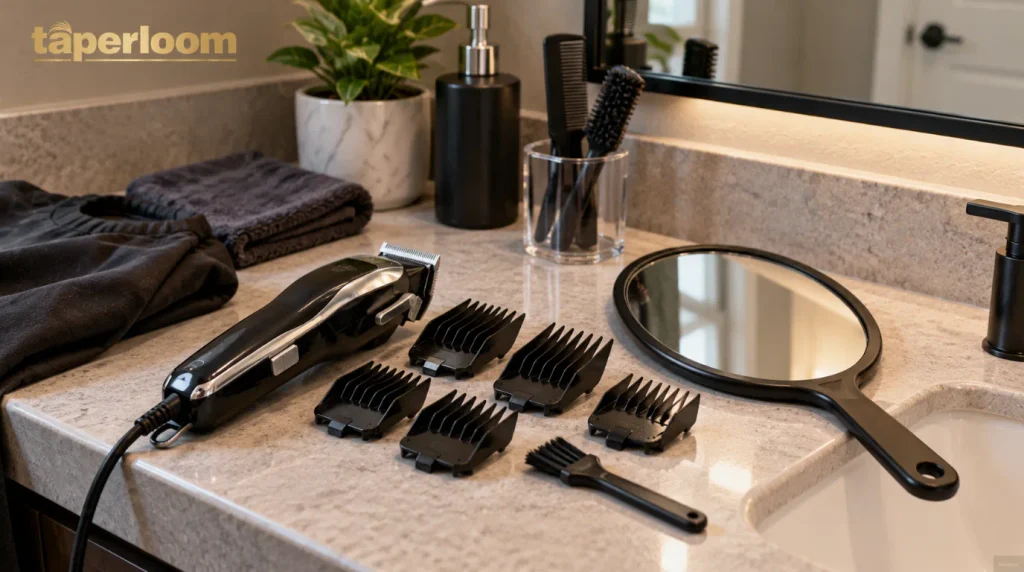
The top is easy: use a single guard in even passes. The burst fade around the ear is the hard part, because it needs curved, consistent blending and an equal result on both sides.
If you try it:
- Use quality clippers with a full guard set and a handheld mirror for the back.
- Work from longer to shorter guards, and move the clipper in the curve of the ear.
- Start with a longer guard than you want. You can always cut shorter.
- Leave the neckline and line up to a barber if you’re not confident.
For a first burst fade, go to a barber. Then use that cut as a model for home maintenance.
Who Should (and Shouldn’t) Get One
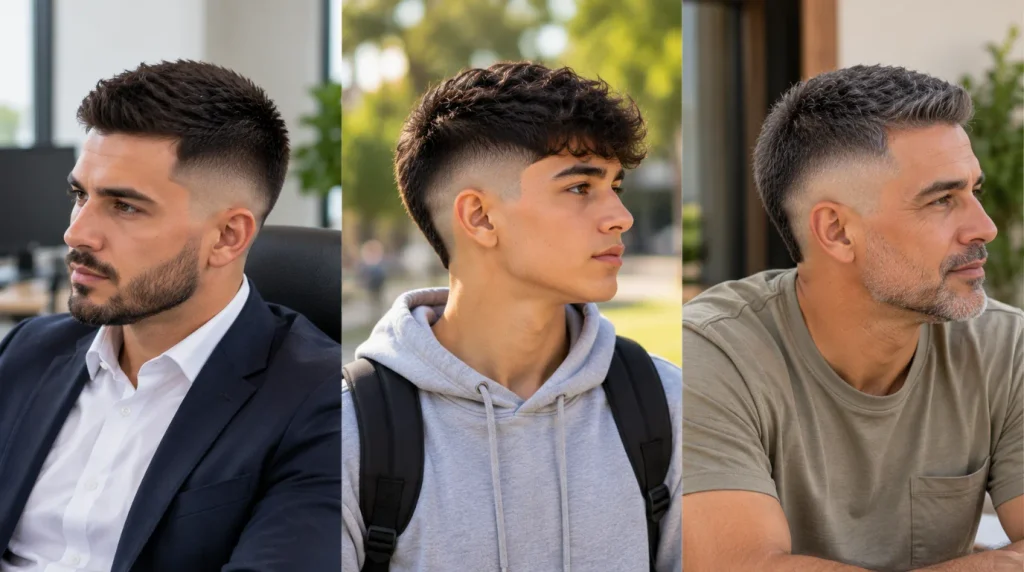
Pros and Cons
| Pros | Cons |
| Very little daily styling | Needs touch-ups every 2 to 3 weeks |
| Works with most hair types | Skin finishes show scalp marks and can cause bumps |
| Flatters many face shapes | Hard to replicate at home |
| Pairs well with beards and designs | Limited if you want length |
| Cool in warm weather | High fades grow out visibly fast |
Verdict: a strong choice for men who want low styling effort and a sharp outline and don’t mind regular barber visits. If you prefer length or frequent restyling, choose something else.
Workplace
A low or mid burst with a shadow finish and a #2 or #3 top reads polished in most offices. Skip designs and a very high fade for conservative settings.
Kids and Teens
It works well for children because it’s low maintenance. Keep it simple, with a low burst and no razor finish, and ask the barber to go gentler on young skin.
Older Men
A low burst with a #3 or #4 top looks neat and keeps some coverage. It also handles thinning evenly.
Sports and Active Lifestyles
Easy to wash, quick to dry, and cool in heat. Wear sunscreen for outdoor sports.
Quick Decision Guide
- Need it office-safe? Low burst, shadow finish, #2 or #3.
- Want maximum sharpness? Mid or high burst, skin finish, #1 or #2. Plan for frequent touch-ups.
- Curly or coily, with bump-prone skin? Shadow finish, slightly longer sides, no razor.
FAQs
What is a burst fade buzz cut?
A short, evenly clipped top with a curved fade wrapping around the ear.
What guard number is best?
A #2 or #3 on top is a common starting point, with the fade blending to skin or a #0/#1 at the ear.
How often should I trim it?
About every 2 to 3 weeks to keep the fade sharp.
How long does it last?
The top looks fine for weeks, but the fade usually looks soft after 2 to 3.
Does it work for thick hair?
Yes. The fade removes side bulk and keeps the shape tidy.
Is it good for thinning hair?
Yes, with an even, short top and a mid or low fade.
Does it suit round faces?
Often, especially a mid or high burst with a little more length on top.
Can I get one with a beard?
Yes, and it’s one of the best pairings if the beard is shaped to match.
What’s the difference between a burst fade and a skin fade?
Burst describes the curved shape around the ear. Skin describes the finish at bare skin. You can combine them.
Does it work for curly hair?
Yes. Ask for a shadow finish if you’re prone to ingrown hairs.
Can I do it at home?
The buzzed top, yes. The curved fade is hard to blend evenly, so a barber is recommended.
Is it appropriate for work?
A low or mid burst with a clean top is polished enough for most workplaces.
Final Thoughts
The burst fade buzz cut is simple on top and detailed at the sides, which makes it a good fit for men who want a sharp look with little styling.
Choose a guard number, a fade height and a finish. Take a reference photo to the barber, and schedule touch-ups every few weeks. Protect your scalp from the sun, and go easy on very close finishes if your skin is bump-prone.
Related Guides.
- 12 Guard Buzz Cut: Length, Looks, and Exactly What to Tell Your Barber
- 10 Guard Buzz Cut: Exact Length, Styles & Barber Guide (2026)
- 7 Guard Buzz Cut: Length, Fade Styles & Barber Guide (2026)
- Long Buzz Cut: Guard Lengths, Fades & Barber Guide (2026)

Muhammad Kaleem is a content creator who writes about hair care, hairstyles, grooming, and everyday hair trends. He enjoys turning hair-related topics into simple, practical, and easy-to-understand content that helps readers make informed choices about their hair and personal style.