

The buzz cut mullet hairstyle puts two cuts that look like opposites on one head. Your top and sides stay clipped short and clean, while the nape keeps its length.
You get the low maintenance ease of a buzz cut and the attitude of a mullet, without the shaggy 1980s look.
It’s also one of the easier ways to try a mullet, because you only grow out the back and leave the rest short. This guide covers 16 styles, the guard sizes behind them, and exactly what to say to your barber.
A buzz cut mullet is a haircut with a very short top and sides, usually clipped with a #1 to #3 guard, and noticeably longer hair at the nape. It works on straight, wavy, curly and coily hair, needs almost no daily styling, and looks sharpest with a low fade or taper.
At a Glance
| Feature | Details |
| Top length | #1 to #3 guard (3 to 10 mm). Go up to #6 (19 mm) for a softer, textured top |
| Sides | Uniform buzz, taper, or a fade (low, mid, high, skin or burst) |
| Back (nape) length | From a slightly longer nape to shoulder length, depending on how bold you want it |
| Maintenance | Refresh the top and sides every 2 to 4 weeks. Let the nape grow |
| Best hair types | Straight, wavy, curly and coily |
| Styling time | 0 to 5 minutes |
What Is a Buzz Cut Mullet?

A buzz cut mullet is a haircut with a short, clippered top and sides and a noticeably longer nape. The short areas give you the clean look of a buzz cut. The longer back gives you the mullet’s shape.
The whole point is contrast. A regular buzz cut keeps your entire head at about one length. This cut splits your head into two clear zones, so the back stands out against the cropped top and sides.
It also differs from a classic mullet. The top isn’t layered or styled into volume. It’s simply cropped short, and that’s why the cut needs so little daily effort.
You can dial it up or down. A subtle version leaves only a small extension below the ears. A bold version keeps several inches through the back. The sides can stay one uniform length, or you can add a taper or a fade.
Buzz Cut Mullet vs Similar Haircuts
Several cuts look alike from certain angles, but their structure is different. Here’s how they compare:
| Haircut | Top | Sides | Back | What sets it apart |
| Buzz cut mullet | Very short (#1 to #3) | Buzzed, tapered or faded | Deliberately longer | Cropped top with a long nape |
| Buzz cut | Short and even | Short and even, or faded | Short | The whole head stays at about one length |
| Classic mullet | Short to medium, often layered | Short | Long | Layered and styled, with more volume overall |
| Tellum (reverse mullet) | Long in front | Varies | Short or buzzed | The mullet flipped, long in front and short at the back |
| Mohawk fade | Longer center strip | Heavily faded | The strip can run down to the nape | A narrow strip of length down the middle |
| Burst fade mullet | Varies | Curved fade around the ear | Length preserved | Defined by the shape of the fade |
Some of these overlap. A buzz cut mullet can have a burst fade, so the two names aren’t rivals. One describes the length pattern (short top, long nape). The other describes how the fade curves around your ear.
Quick test: Look at the top and the back. Short top and long nape means buzz cut mullet. Long front and short back means tellum. A narrow strip down the middle means mohawk fade.
Anatomy of the Cut
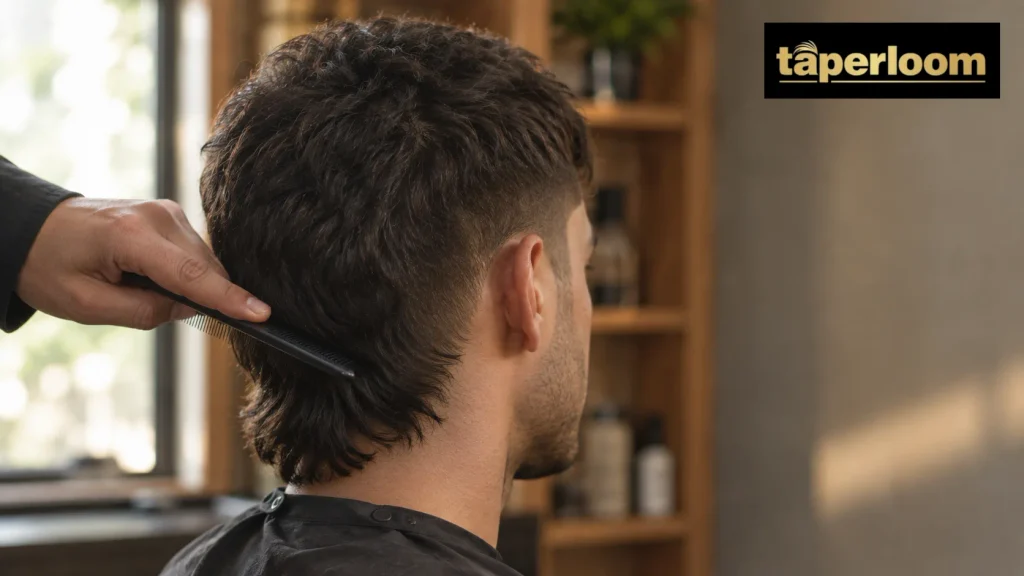
Every buzz cut mullet is built from four zones. Once you know them, it’s much easier to explain what you want.
| Zone | Where it sits | Typical length | Its job in the cut |
| Top | From the front hairline back to the crown | #1 to #3 (3 to 10 mm), up to #6 (19 mm) for texture | Sets how bold or soft the cut looks |
| Sides | Above and around the ears | Buzzed, tapered or faded | Controls the contrast and the outline |
| Crown | The rounded area at the back where the top meets the nape | Medium, blended | Connects the short top to the long nape |
| Nape | The lower back of the head down to the neckline | 2.5 cm (1 in) to shoulder length | Gives the cut its mullet identity |
Picture your head from the side. The top and sides stay short. The crown acts as the bridge. The nape hangs longer at the bottom. If the crown is buzzed too far down, the mullet disappears. If it’s left bulky and unshaped, it forms a ledge.
The line where short hair meets long hair is called the
weight line. Where your barber places it decides whether the cut looks smooth or sharply disconnected.
Guard Size Chart
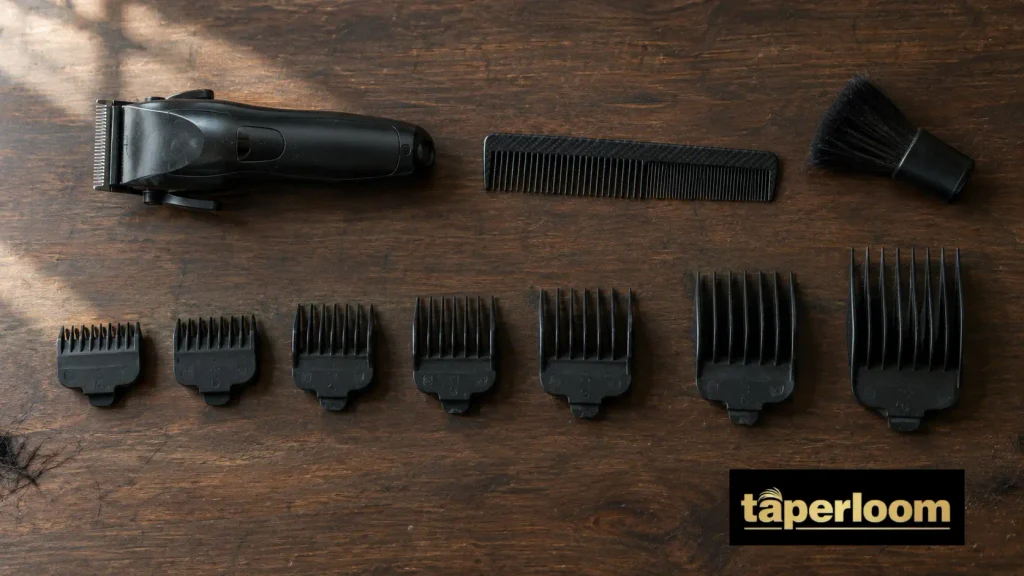
Clipper guards decide how short your top and sides end up. Here’s what each one leaves behind:
| Guard | Length | Inches | Common use in this cut |
| No guard | Under 2 mm | Under 1/16 | Base of a skin fade |
| #1 | 3 mm | 1/8 | Very short top, tight sides |
| #2 | 6 mm | 1/4 | The safest starting point for the top |
| #3 | 10 mm | 3/8 | Softer top, gentle taper |
| #4 | 13 mm | 1/2 | Longer buzz with light texture |
| #5 | 16 mm | 5/8 | Textured top |
| #6 | 19 mm | 3/4 | Longest common buzz on top |
| #8 | 25 mm | 1 | Very soft, almost a short crop |
Guard sizes can vary slightly by brand. Check your clipper’s manual if you plan to cut at home.
16 Buzz Cut Mullet Styles
Each style below uses the same card, so you can compare them quickly. The styles are grouped by sides, top length, back length, hair type, and one special cut.
Styles by Sides
1. Classic Uniform Sides Buzz Cut Mullet
The simplest version. The top and sides share one short guard, and the nape stays long.
- Best for: First timers, straight or wavy hair, and anyone who wants zero fade upkeep
- Guard combo: Top #2, sides #2, nape 5 to 8 cm (2 to 3 in)
- Tell your barber: “Clip the top and sides with a #2 all over, keep the nape long, and blend the crown so it doesn’t look chopped.”
- Styling: None. A pea size of matte paste on the nape is optional.
- Maintenance interval: Every 3 to 4 weeks
- Mistake: Running the same guard down the back of the head, which erases the mullet
2. Taper Buzz Cut Mullet
A taper shortens the hair gradually around the ears and sideburns. It looks neat and works in more formal settings. Want the same soft blend with more length on top? Read our guide to a low taper fade with a textured fringe.
- Best for: Office settings and a clean, softer look
- Guard combo: Top #3, sides tapering from #1 at the edge to #3, nape 7 to 10 cm (3 to 4 in)
- Tell your barber: “Taper around my ears and sideburns only, keep the top at a #3, and leave the nape length alone.”
- Styling: Comb or finger through, no product needed
- Maintenance interval: Every 3 to 4 weeks
- Mistake: Letting the taper climb up the back and eat into the nape
3. Low Fade Buzz Cut Mullet
A low fade keeps the shortest hair near the ear and lower sides, so more weight stays above it. That softens the jump into the crown.
- Best for: A visible fade without exposing much of the side profile
- Guard combo: Top #2, low fade from skin to #2, nape 7 to 10 cm (3 to 4 in)
- Tell your barber: “Low fade around the ears, and stop the fade before it reaches my nape.”
- Styling: None needed
- Maintenance interval: Every 2 to 3 weeks
- Mistake: Letting the fade wrap around into the back of the head
4. Mid Fade Buzz Cut Mullet
A mid fade rises higher on the sides. The contrast with the nape gets stronger, and more of your head shape shows.
- Best for: A sharper, more modern outline
- Guard combo: Top #2, mid fade from skin to #2, nape 8 to 10 cm (3 to 4 in)
- Tell your barber: “Mid fade blending into a #2 top, ending at the back of my ear line so the nape stays long.”
- Styling: None needed
- Maintenance interval: Every 2 to 3 weeks
- Mistake: Picking a fade height without thinking about how it meets the back
5. High Fade or Skin Fade Buzz Cut Mullet
The strongest contrast in the group. Much of the side is clipped to bare skin or close to it, so the nape looks even longer.
- Best for: Bold styles, dense hair, and people who are happy to show scalp
- Guard combo: Top #1 or #2, high skin fade, nape 10 cm (4 in) or more
- Tell your barber: “High skin fade blending into a #2 top. Protect the crown and nape completely.”
- Styling: None. Moisturize the exposed scalp.
- Maintenance interval: Every 2 weeks, because skin fades soften fast
- Mistake: Going straight to a skin fade before you know how your head shape looks at that length
6. Burst Fade Buzz Cut Mullet
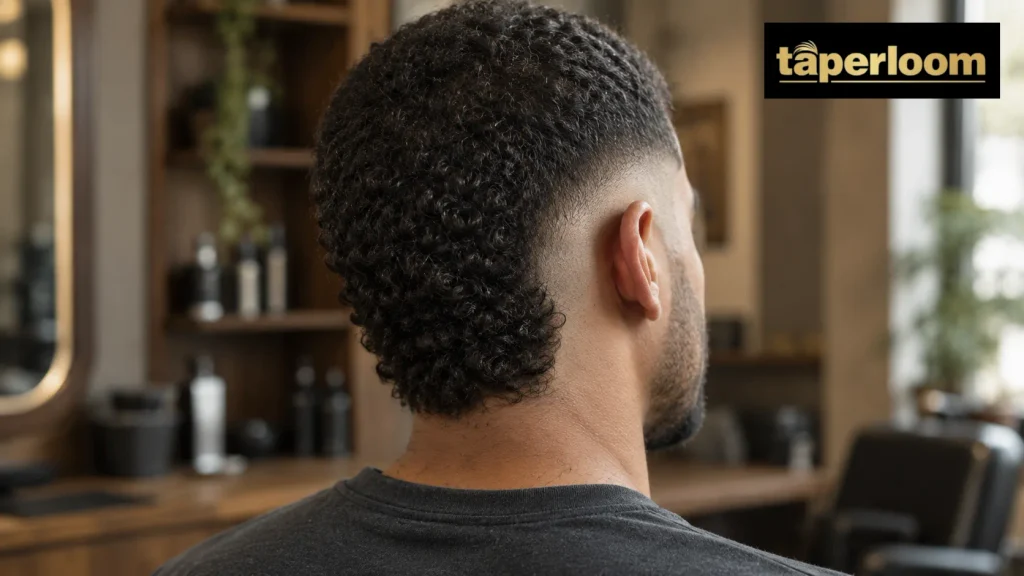
A burst fade curves around the ear instead of running straight across the side. The length behind it stands out like a strip flowing toward the nape.
- Best for: Wavy or curly hair, and anyone who wants the mullet shape to show from the side
- Guard combo: Top #2, burst fade around each ear from skin to #3, nape 10 cm (4 in)
- Tell your barber: “Burst fade around each ear, curved back, with everything behind the ear kept at length.”
- Styling: Curl cream or light mousse on the nape if your hair has texture
- Maintenance interval: Every 2 to 3 weeks
- Mistake: Cutting the burst too deep behind the ear and losing the nape
Styles by Top Length
7. #1 Top Buzz Cut Mullet
A #1 leaves 3 mm of hair. The scalp shows, and the nape becomes the main feature.
- Best for: Dense hair, strong head shapes, and hot climates
- Guard combo: Top #1, sides skin to #1, nape 10 cm (4 in) or more
- Tell your barber: “#1 on top with a low fade. Keep my crown and nape untouched.”
- Styling: None. Use sunscreen on exposed scalp.
- Maintenance interval: Every 2 weeks for the top
- Mistake: Going to a #1 before you know your head shape. Start at #2 if you’re unsure.
8. #2 Top Buzz Cut Mullet
A #2 is the sweet spot for most people. It’s short enough to contrast with the nape and long enough to avoid a shaved look.
- Best for: Most hair types and first time buzz mullet wearers
- Guard combo: Top #2, sides low fade to #1, nape 7 to 8 cm (3 in)
- Tell your barber: “#2 on top, low fade on the sides, and keep the length at the back.”
- Styling: None needed
- Maintenance interval: Every 3 weeks
- Mistake: Saying “#2 all over” when you want shorter sides
9. Longer Buzz Cut Mullet with Soft Texture (#4 to #6)
At 13 to 19 mm, your hair is long enough to show texture. The result reads softer and less severe.
- Best for: Wavy or curly hair, and anyone who prefers a gentler contrast
- Guard combo: Top #5, sides taper from #2 to #3, nape 8 to 10 cm (3 to 4 in)
- Tell your barber: “#5 on top with light texture, taper the sides, and blend the crown into the nape.”
- Styling: A pea size of texture powder or matte clay, worked in with your fingertips
- Maintenance interval: Every 3 to 4 weeks
- Mistake: Using too much product, which makes short hair look coated
Styles by Back Length
10. Short Subtle Nape Buzz Cut Mullet
Only 2.5 to 5 cm (1 to 2 in) of extra length. From the front, it can pass as a neat short haircut.
- Best for: First timers, workplaces with grooming rules, and testing the look before committing
- Guard combo: Top #2, sides #1 to #2, nape 2.5 to 5 cm (1 to 2 in)
- Tell your barber: “Leave about an inch or two at the nape and blend everything else short.”
- Styling: None needed
- Maintenance interval: Every 3 weeks. Ask for sides only.
- Mistake: Cleaning the neckline so high that it looks like a regular buzz cut
11. Neck Length Classic Buzz Cut Mullet
The nape reaches your collar. This is the version most people picture when they hear “mullet.”
- Best for: The classic look with clear contrast
- Guard combo: Top #2 or #3, sides #2, nape 8 to 10 cm (3 to 4 in)
- Tell your barber: “Neck length back, buzzed top and sides, no layers at the nape.”
- Styling: Finger comb it. A little matte cream helps if it flips.
- Maintenance interval: Sides every 3 weeks. Trim only the ends of the nape every 8 to 12 weeks.
- Mistake: Letting the edges go ragged. A quick shape up keeps it neat.
12. Long Back Buzz Cut Mullet
Several inches of length, up to your shoulders. The nape becomes the star of the cut.
- Best for: Thick, wavy or curly hair, creative jobs, and confident stylers
- Guard combo: Top #1 or #2, sides faded, nape 13 to 20 cm (5 to 8 in)
- Tell your barber: “Long nape, short buzzed top, and blend the crown so the back doesn’t look stuck on.”
- Styling: Leave in conditioner, then air dry. A low tie is optional.
- Maintenance interval: Sides every 2 to 3 weeks. Trim the nape ends every 8 to 12 weeks.
- Mistake: Skipping the crown blend, which makes the long back look disconnected by accident
Styles by Hair Type
13. Wavy Buzz Cut Mullet
Waves bend more freely as the nape grows, so this cut gives them room to move.
- Best for: Naturally wavy hair
- Guard combo: Top #3, sides low taper, nape 10 cm (4 in)
- Tell your barber: “Leave enough length at the crown so my waves flow into the nape.”
- Styling: Lightweight mousse on damp hair, then air dry
- Maintenance interval: Every 3 to 4 weeks
- Mistake: Using heavy gel, which flattens the waves
14. Curly Buzz Cut Mullet
Curls sit close to the head in the short zones and spring out at the nape. That contrast is the whole appeal.
- Best for: Naturally curly hair
- Guard combo: Top #2 to #4, sides faded, nape 10 to 13 cm (4 to 5 in)
- Tell your barber: “Judge my nape length while my curls are in their natural shape, not stretched.”
- Styling: Curl cream on damp hair, scrunch, then air dry or diffuse on low
- Maintenance interval: Every 3 weeks
- Mistake: Cutting the nape while it’s stretched, then watching it bounce up shorter
15. Coily Buzz Cut Mullet
Coily hair creates a rounded, full nape. Shrinkage can make it look much shorter than it did when stretched. For more fade ideas built around tight textures, see these low taper fade afro styles.
- Best for: Coily and tightly textured hair
- Guard combo: Top #2 or #3, sides faded, nape a little longer than you think you need
- Tell your barber: “Please judge the length after my coils spring back, and leave a bit extra at the nape.”
- Styling: Leave in conditioner or a light oil, then shape with your fingers or a pick
- Maintenance interval: Fade every 2 to 3 weeks. Keep the nape moisturized.
- Mistake: Choosing the nape length while the hair is stretched
Special Style
16. Disconnected Two Block Buzz Cut Mullet
Instead of hiding the jump in length, this version makes it the feature. There’s little blending between the short top and the long nape.
- Best for: Bold, confident stylers who want strong contrast
- Guard combo: Top #2, sides faded from skin to #1, nape 13 cm (5 in) or more
- Tell your barber: “I want a clear, deliberate disconnection at the crown with a clean line, not a blended transition.”
- Styling: Texture spray on the nape for movement
- Maintenance interval: Every 2 to 3 weeks to keep the line sharp
- Mistake: Leaving the disconnection to chance. A planned line looks intentional, and an accidental ledge looks unfinished.
Which One Suits You?
Use this table as a guide, not a rulebook. Your hair density, head shape and personal taste matter more than any label.
| Factor | Your situation | Try this |
| Hair type | Straight | Classic uniform or Taper, with a narrower nape |
| Wavy | Wavy style with a fuller crown | |
| Curly | Curly style, cut in natural shape | |
| Coily | Coily style with extra nape length | |
| Face shape (guideline) | Round | Mid or high fade to slim the sides |
| Square | Low fade or Taper for a softer outline | |
| Oval | Most styles work | |
| Heart | Longer buzz on top (#4 to #6) with a fuller nape | |
| Long | Taper or low fade to keep some width at the sides | |
| Hairline | Strong, even hairline | #1 or #2 top |
| Receding | #3 to #6 top, which softens the contrast with your scalp | |
| Crown swirl or cowlick | #3 or longer at the crown | |
| Head shape | Unsure how it looks short | Start with #3 or #4, then go shorter next visit |
| Lifestyle or job | Strict dress code | Short subtle nape with a Taper |
| Creative or casual | Long back with a fade | |
| Athlete or hot climate | #1 or #2 top, plus scalp sunscreen | |
| Lowest upkeep | Classic uniform sides | |
| School age or teen | Short subtle nape with a taper. Check the dress code first, and see our low taper fade for kids barber scripts |
What to Tell Your Barber
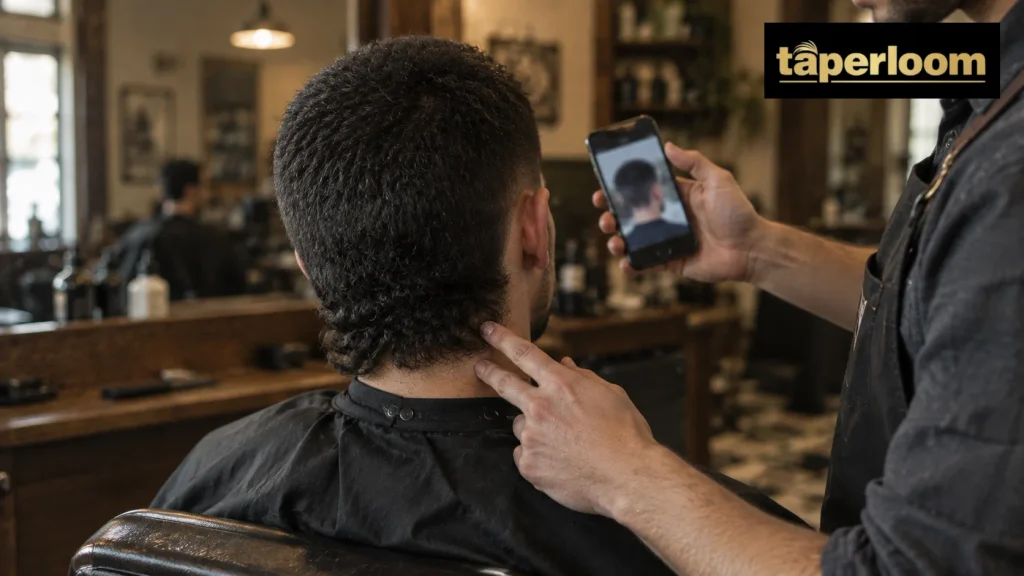
“Buzz cut mullet” describes the idea, but it doesn’t give your barber enough detail. A few specific words prevent most disappointments.
Copy and Paste Script
“I’d like a buzz cut mullet. Please keep the top at a #2 and take the sides down with a low fade that stops at the back of my ears. I want to keep about 3 inches at the nape and blend the crown so there’s no hard ledge. Please don’t buzz the back or clean up the nape without checking with me first. I’d like a natural neckline.”
Swap in your own guard, fade height and nape length.
10 Point Checklist
- Top length or guard number
- Side treatment: uniform, taper, or fade
- Fade height: low, mid or high
- Shortest point: skin or a shadow of hair
- Crown weight: how much stays
- Nape length in inches or centimeters
- Blended or disconnected transition
- Neckline: natural, rounded or squared
- Sideburn length
- Front hairline: natural or a lineup
Reference Photos
Bring three angles if you can: front, side and back. Pick photos of hair with a similar texture and density to yours, because the same cut can look very different on straight and coily hair. It also helps to show one photo of what you don’t want. Keep the message simple: “This top length, this fade, this much at the back.”
How to Do It at Home (Safely)

A barber will always do a cleaner fade. But if you want to try a uniform buzz cut mullet at home, this is the safest way.
What you’ll need: clippers with guards, a trimmer, two mirrors, a comb, hair clips, and a towel.
The “Start Longer” Rule
Always begin with a longer guard than you think you need. You can cut hair shorter in a minute, but you can’t add it back. Move from the longest guard to the shortest, never the other way around.
Step by Step
- Section the nape. Comb the back hair down and clip it away from the area you’ll be buzzing. Mark where the nape length should start at the crown.
- Buzz the top. Start with #4, then go down to #3 or #2 if you want it shorter.
- Do the sides. Start with #3, then #2. Lift the clippers slightly at the edge to soften the line.
- Blend the crown. Go over the transition area with a slightly longer guard so it doesn’t look chopped.
- Check every angle. Use two mirrors to check the front, side and back.
- Clean the neckline gently. Use the trimmer only around the edge. Leave the nape length alone.
What Not to Do
- Don’t start with the shortest guard
- Don’t buzz past your crown line
- Don’t try a skin fade on your first attempt
- Don’t cut curly hair stretched or wet
- Don’t rush the neckline
Styling by Hair Type
This is a low effort haircut. Most of the styling happens at the nape.
| Hair type | Routine | Minimal products |
| Straight | 0 minutes. Towel dry and go. | Matte paste (optional) |
| Wavy | 2 minutes. Damp hair, then air dry. | Lightweight mousse |
| Curly | 5 minutes. Scrunch and diffuse on low. | Curl cream |
| Coily | 5 minutes. Moisturize, then shape. | Leave in conditioner, light oil |
The buzzed sections rarely need any product. Heavy products weigh down the nape, so start small and add more only if you need it.
Maintenance & Grow Out Timeline
Different zones of the cut lose their shape at different speeds. Hair grows about 1.25 cm (half an inch) per month on average, so plan around that.
| Timeline | Fade and sides | Top | Nape |
| Weeks 1 to 2 | Sharpest. Skin fades soften first. | Fresh | Leave alone |
| Weeks 3 to 4 | Book a refresh for fades | Refresh if you keep it very short | Leave alone |
| Weeks 5 to 8 | Second refresh | Longer buzz tops can go longer | Shape the ends only |
| Weeks 9 to 12 | Refresh regularly | Regular maintenance | Visible growth, about 3.75 cm (1.5 in) |
| Month 4 and beyond | Keep the schedule | Keep the schedule | Trim the ends only, every 8 to 12 weeks |
Growing a Buzz Cut Into a Mullet
Keep your top and sides short while the nape grows. If you’re starting from a short buzz, a 7.5 cm (3 in) nape takes roughly six months. Ask your barber to preserve the crown too, so the transition catches up instead of leaving a gap.
Scalp Care
A short top leaves more scalp exposed, so look after it:
- Use SPF 30 or higher on exposed scalp in the sun, or wear a hat
- Wash with a mild shampoo and avoid harsh scrubbing
- Moisturize the scalp if it feels dry
- Keep clipper blades clean to protect your neckline skin
Common Mistakes
- Buzzing the crown too short. The short top runs too far down the back and there’s no hair left to connect to the nape.
- Cleaning the nape at every visit. You can lose months of growth without noticing. Say “sides only” each time.
- Ignoring curl shrinkage. Curly and coily hair springs back shorter. Judge the length in its natural shape.
- Choosing fade height without thinking about the back. A high fade can take away side and rear weight you wanted to keep.
- Going too short too fast. A #1 exposes your head shape completely. Start with #2 or #3.
- Copying a photo with different hair. A cut that looks great on thick straight hair won’t fall the same way on fine or coily hair.
- Using too much product on the nape. It weighs the hair down and makes the cut look greasy.
- Skipping scalp sun protection. A shorter top means more exposure.
- Using a vague request. “Short on top, long at the back” isn’t enough. Give numbers.
FAQ
Is a buzz cut mullet a real mullet?
Yes. It keeps the mullet’s core idea of shorter hair on the top and sides and length at the nape. The top is simply shorter than on a classic mullet.
What guard is best for a buzz cut mullet?
A #2 guard (6 mm) is the safest starting point for most people. Go #1 for stronger contrast, or #3 to #6 for a softer, more textured top.
Does a buzz cut mullet suit a round face?
Yes, it can. A mid or high fade slims the sides, and the longer nape adds length to the outline. Treat this as a guideline, since your hairline and head shape matter too.
How does a buzz cut mullet look with a receding hairline?
It can work, but a very short top shows the hairline more. A #3 to #6 top softens the contrast between scalp and hair.
How long should the back be?
Anywhere from 2.5 cm (1 in) for a subtle look to shoulder length for a bold one. Most people land around 7 to 10 cm (3 to 4 in), near the collar.
How often should I trim it?
Refresh the fade and top every 2 to 4 weeks. Leave the nape alone, or trim only the ends every 8 to 12 weeks.
Can I do a buzz cut mullet at home?
Yes, if you keep the sides uniform and use guards from longest to shortest. Leave fades to a barber unless you’re experienced.
Is a buzz cut mullet okay for the office?
Yes, in a subtle version. A short nape, a taper and a #3 top look neat in most workplaces.
Does a buzz cut mullet work on curly hair?
Yes. The curls compress on the short areas and spring out at the nape. Judge your nape length when your curls are in their natural shape.
How long does it take to grow a buzz cut into a mullet?
About six months to reach a 7.5 cm (3 in) nape from a buzz, based on roughly 1.25 cm (half an inch) of growth per month.
Conclusion
The buzz cut mullet hairstyle is all about contrast. A short, easy top meets a nape with real character, and the guard, fade and length choices let you make it as subtle or as bold as you like.
Start with a #2 top, pick the fade that suits your style, and give your barber exact numbers. Keep the nape safe during cleanups, and you’ll have a cut that’s easy to live with and hard to mistake for anything else.
Keep reading on TaperLoom:
- Textured Fringe With Low Taper Fade: 2026 Style Guide
- Low Taper Fade Afro: 30 Best Styles for Every Hair Type
- Low Taper Fade for Kids: 20+ Styles & Barber Guide

Muhammad Kaleem is a content creator who writes about hair care, hairstyles, grooming, and everyday hair trends. He enjoys turning hair-related topics into simple, practical, and easy-to-understand content that helps readers make informed choices about their hair and personal style.